


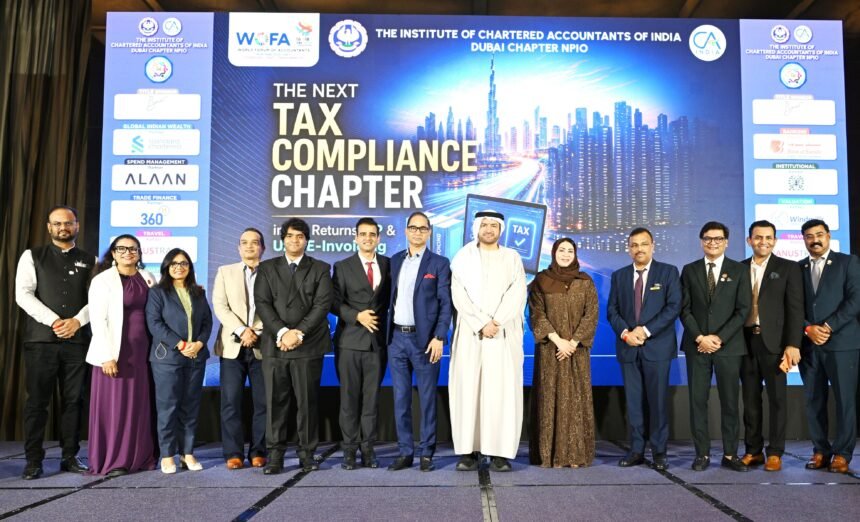
Dubai, UAE– UAE corporates and businesses should use the time available to prepare for E-Invoicing that becomes effective in phases from January 1, 2027 – or just over three months, according to officials and experts who spoke at a conference titled: The Next Tax Compliance Chapter in Corporate Tax Returns, Transfer Pricing and E-Invoicing, organised by the Dubai Chapter of the Institute of Chartered Accountants of India (ICAI).
The UAE is introducing a mandatory Electronic Invoicing (E-Invoicing) system managed by the Federal Tax Authority (FTA) to improve tax transparency and reduce fraud. E-Invoicing is a key step in the UAE’s digital transformation journey, enabling secure, structured and fully electronic exchange of invoice data between businesses and reporting it to the FTA.
The conference, attended by more than 500 members of ICAI, featured keynote addresses by eminent speakers who urged professionals to focus on their mind, sharpen them and utilise the power of mind.
“We are fortunate enough to be witnessing, and as Chartered Accountants being part of an exciting time that will be remembered in history for a smooth migration from a non-tax to a tax environment. By implementing the international best practices in taxation, the UAE has taken a leadership role in its migration to the tax environment that has so far been smooth,” CA Rishi Chawla, Chairman of the Dubai Chapter of the ICAI, said in his opening remarks at the conference.
“With the E-Invoicing programme that is going to be implemented next year, we can see that the country is becoming a role model in this transformation, The FTA is gradually preparing the stakeholders for the most transparent tax environment and as Chartered Accountants, I’m sure we are more than ready for this game-changing transformation.”
E-invoicing refers to the automated creation, sending, and processing of digital billing documents between businesses and governments without manual work. By introducing E-Invoicing, the UAE wants to be a key enabler of a modern digital and paperless economy while maximising UAE Federal Government revenue collection, reduce tax gaps and tax evasion and creating a balanced playing field for all businesses and thereby enhancing the ease of doing business.
The UAE collected more than Dh46 billion (US$12.5 billion) in Value Added Tax (VAT) and Excise Tax revenues in 2025, marking a 15 percent increase from Dh41 billion in 2024.
Dr. Zahra Al Dahmani, Director of Tax Payer Services Department Federal Tax Authority, says, “When people hear about E-Invoicing, they think about compliance or just another administrative requirement. But the reality is, E-Invoicing is much bigger than that. E-Invoicing represents another important step in the UAE’s digital transformation and in the continued development of a tax system that is efficient, transparent and designed to support a model economy.
“Technology has helped reshape the UAE’s progress for many years not because we adopt innovation for its own sake, but because we recognise its ability to simplify the processes, improve services and create new opportunities. Our approach has also been guided by flexibility and international best practices. The UAE has adopted a decentralised continuous transaction, control and exchange model, commonly known as the Five-Corner Model, allowing businesses to exchange e-invoices through the Accredited Service Providers using internationally recognised standards.”
Explaining the role of the Ministry of Finance, Federal Tax Authority and the Accredited Service Providers, she said, “We have now reached at an important stage in the programme – the Pilot Phase – is underway. Businesses can now onboard their Accredited Service Provider through Emaratax and participating organisations can begin issuance and exchange of E-Invoices during the testing processes. The programme has now moved from planning to implementation stage – which brings me to my main message – Use the time available to prepare!”
According to the global industry authority Billentis, approximately 125 billion electronic invoices are issued annually worldwide out of a total global invoice volume of 600 billion. The global e-invoicing market is valued at approximately US$18.5 billion and is projected to grow to over US$70 billion by 2034. More than 80 countries plan to enforce structured e-invoicing rules by 2027 to close tax gaps.
The UAE has more than 1.4 million registered businesses and 245,000 of them have applied for Corporate Tax registration, so far.
Hisham Al Taher Board Member, Chairman, Tax Committee / Media Affairs Emirates Association for Accountants & Auditors, said, “Putting the words ‘tax’ and ‘happiness’ together in the same statistics is not an easy achievement. For many years, we considered an invoice as a piece of paper. Now it is gradually becoming a structured data that can travel between systems that remains there as a record that we could later analyse.
“For me it is not just another project – but a complete business transformation – that makes tax more transparent and helps businesses operate better.”
With more than 3,200 members, ICAI Dubai Chapter is the largest business group in the UAE. Established in 1982, it is also the largest, most active and award-winning chapter among the 44 overseas chapters of ICAI. It has registered a phenomenal growth in membership has exceeded 3,200 members who represent more than 1,550 multinationals and other companies.
CA Mithilesh Reddy, Founder and CEO of SBC Tax Consulting, said, “It has been a remarkable few-year journey of implementation of the Corporate Tax in the UAE. I remember, in 2022–23, when we were discussing transfer pricing and the introduction of corporate tax, we were also involved in preparing the guidance notes from Delhi.
“I still remember participating in the Train the Trainer programme. From there onwards, we worked on the guidance notes, and today, we are here discussing the second year of implementation. It has been a remarkably smooth journey. There have been no extensions and no major confusion. The system has been integrated smoothly, and that deserves recognition.”
ICAI is the largest professional body of Chartered Accountants across the world with over 1,000,000+ students and around 450,000+ members. ICAI has a wide network with five Regional Councils, 176 Branches, 54 Overseas Chapters, and 31 representative offices across the globe. And among 54 overseas chapters, ICAI Dubai Chapter is the largest and most vibrant chapter of ICAI. Of the 8,000 Indian Chartered Accountants active in the UAE‘s private sector, 1,400+ are currently leading businesses in senior positions.
SOURCE: MEDIA RELEASE / SUPPLIED CONTENT WITH IMAGE