


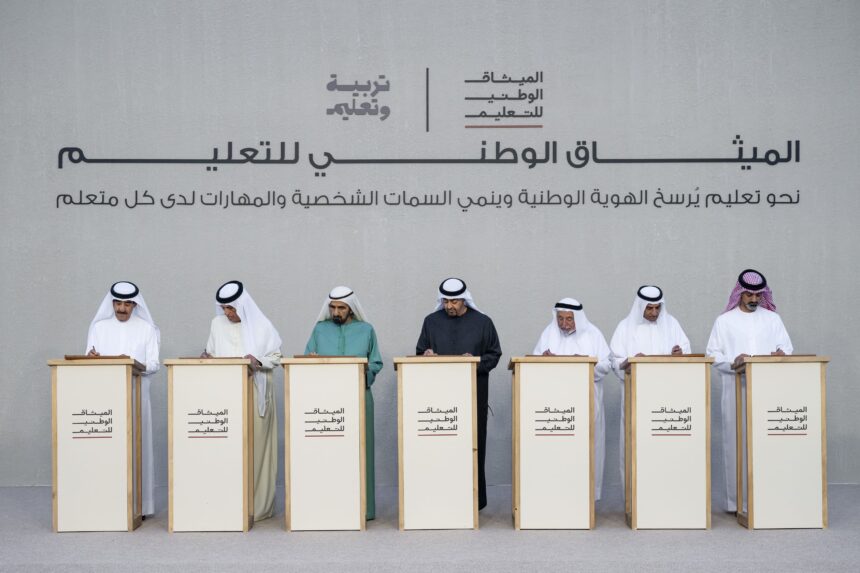
ABU DHABI, 28th February, 2026 (WAM) – President His Highness Sheikh Mohamed bin Zayed Al Nahyan has launched the National Education Charter, establishing a national reference that defines the vision, purpose, and long-term outcomes of education in the United Arab Emirates.
The Charter sets out a unified foundation for the education system, the profile of the Emirati graduate, and the values and future competencies that will guide the nation’s learning journey, thereby reinforcing education as a sovereign priority and a central pillar of human development and nation-building.
The charter was signed during a ceremony held at Qasr Al Bahr by President His Highness Sheikh Mohamed bin Zayed Al Nahyan; His Highness Sheikh Mohammed bin Rashid Al Maktoum, Vice President, Prime Minister and Ruler of Dubai; His Highness Sheikh Dr Sultan bin Mohammed Al Qasimi, Supreme Council Member and Ruler of Sharjah; His Highness Sheikh Hamad bin Mohammed Al Sharqi, Supreme Council Member and Ruler of Fujairah; His Highness Sheikh Saud bin Rashid Al Mualla, Supreme Council Member and Ruler of Umm Al Quwain; His Highness Sheikh Saud bin Saqr Al Qasimi, Supreme Council Member and Ruler of Ras Al Khaimah; and His Highness Sheikh Ammar bin Humaid Al Nuaimi, Crown Prince of Ajman.
The launch coincides with Emirati Day for Education, observed annually on 28th February, underlining the symbolic national importance of the occasion and reaffirming the UAE’s steadfast commitment to education as a sustainable path for development and progress.
The National Education Charter articulates the UAE’s comprehensive vision for the future of education and clearly defines the attributes of the Emirati learner upon whom a values-rooted, globally competitive, and future-ready education system will be built. It establishes a coherent national direction that ensures long-term alignment of education policies, balancing the stability required for institutional continuity with the agility needed to respond to global transformations and the evolving needs of society and the labour market.
On this occasion, President His Highness Sheikh Mohamed bin Zayed Al Nahyan affirmed that education remains the cornerstone of the UAE’s development journey, underscoring that investing in the Emirati citizen is the true guarantee of sustainable prosperity and long-term progress.
His Highness stated, “Building individuals who are proud of their national identity, firmly rooted in the Arabic language and Islamic values, and equipped with the skills of the future is a steadfast national priority and a strategic objective. We are advancing this through a fully integrated national education system that places the learner at the heart of development and ushers in a new phase defined by clarity of purpose, policy coherence, and sustainable impact.”
His Highness added that human development is the core and central pillar of the Charter. It seeks to prepare an educated Emirati generation that is confident, deeply connected to its national identity, guided by the values of loyalty and belonging, and driven by initiative and responsibility. The Charter defines the profile of the Emirati learner by bringing together a firmly rooted national identity, balanced personal attributes, and advanced cognitive and practical competencies.
His Highness further emphasised that education is the pathway to achieving the UAE’s broader national vision across all sectors by preparing generations capable of leading the future. This requires strengthening governance across the sector and continuously enhancing policies in line with national ambitions. He noted that the Charter serves as a clear roadmap for elevating the education sector and achieving its strategic national objectives.
His Highness also underscored that education is a shared national responsibility in which schools, families, and the wider community operate within a unified ecosystem. This collective commitment reinforces national identity, strengthens Emirati values, safeguards national achievements, and prepares multiple generations to contribute with confidence and capability.
He highlighted that rapid global transformation necessitates proactive efforts that anticipate change and convert challenges into opportunities, in turn strengthening the resilience and future-readiness of the education system.
NEWS AND PICTURE COURTESY: WAM NEWS (www.wam.ae)