


From Digital Revolution to Global Recognition; Twelve Years of Modi’s Vision and Leadership

By Advocate Anjana Bhatia D.I, Consulting Editor, EmiratesReporter.com
Dubai, UAE- As an Indian-origin resident who has proudly called the UAE home for more than four decades, I have witnessed India evolve through different political eras, economic cycles and leadership styles. Over these 40-plus years, I have observed India’s journey from afar while remaining deeply connected to my roots. In my personal view, I have rarely seen a leader command the scale of public support, political endurance and transformational ambition that Prime Minister Narendra Modi has demonstrated over the past twelve years. Whether one agrees with all his policies or not, his impact on India’s governance, economy, global standing and national confidence is undeniable.
It is from this perspective that I, Advocate Anjana Bhatia, write about Prime Minister Shri Narendra Modi’s remarkable milestone of completing twelve years in office.
Twelve years ago, on May 26, 2014, Shri Narendra Modi took oath as Prime Minister of India amid enormous public expectations and promises of transformative change. Today, after completing 12 years in office, he stands among the longest-serving and most influential leaders in independent India’s history. Supporters view his tenure as a period that fundamentally altered India’s developmental trajectory through economic reforms, digital innovation, infrastructure expansion, welfare delivery, national security initiatives and a more assertive global presence.
When Narendra Modi assumed office, India was already one of the world’s largest economies. However, his government set out to accelerate growth through a combination of structural reforms, technology-driven governance and direct benefit delivery. One of the most visible transformations has been India’s digital revolution. The Unified Payments Interface (UPI), supported by the government’s broader Digital India initiative, has turned India into a global leader in digital payments. Today, billions of transactions take place every month through digital platforms, bringing financial services to millions who previously lacked easy access to formal banking systems. The Jan Dhan financial inclusion programme, combined with Aadhaar and mobile connectivity, helped create one of the world’s largest digital governance ecosystems.
Infrastructure development has emerged as another defining pillar of the Modi years. Across the country, new highways, expressways, airports, railway upgrades, metro systems and logistics corridors have transformed connectivity. Supporters argue that this unprecedented pace of infrastructure creation has not only improved mobility but also laid the foundation for future economic growth. From rural roads and electrification projects to major urban transport networks, infrastructure has become a central component of the government’s development strategy.
The government’s welfare programmes have also been highlighted as major achievements. Through direct benefit transfers, subsidies and social welfare initiatives, millions of beneficiaries have received assistance with reduced leakages compared to traditional delivery systems. Housing schemes, sanitation programmes, rural electrification efforts and household tap water initiatives have been promoted as examples of governance reaching citizens at the grassroots level. Programmes targeting women, youth and farmers have been presented as part of a broader effort to ensure that economic development translates into social progress.
One of the most politically significant decisions during Modi’s tenure was the abrogation of Article 370 in August 2019, which revoked the special constitutional status of Jammu and Kashmir. For decades, the issue had remained one of the Bharatiya Janata Party’s core ideological commitments. Supporters hailed the move as a historic step toward national integration and equal application of laws across India. Critics expressed concerns about the process and its implications, but there is little doubt that the decision ranks among the most consequential constitutional changes in modern Indian history.
Another landmark reform was the legislation against instant Triple Talaq, or Talaq-e-Biddat. The law criminalized the practice whereby a Muslim man could instantly divorce his wife by pronouncing “talaq” three times. The government described the measure as a major step toward gender justice and women’s empowerment. Supporters viewed it as a long-overdue reform protecting the rights and dignity of Muslim women.
On the economic front, the Modi government pursued several major reforms aimed at modernizing India’s economy. Measures such as the Goods and Services Tax (GST), efforts to improve the ease of doing business, manufacturing initiatives like Make in India, and policies encouraging entrepreneurship sought to strengthen India’s competitiveness. India’s economy has expanded significantly during this period and remains one of the fastest-growing major economies in the world. The government has repeatedly articulated its vision of transforming India into a developed nation by 2047, the centenary of independence.
India’s rise in renewable energy has also become a notable feature of the past decade. The country has rapidly expanded its solar energy capacity and emerged as an important player in the global clean energy transition. Green hydrogen initiatives and commitments toward sustainable development have further enhanced India’s profile in international climate discussions. Supporters argue that these achievements demonstrate how economic growth and environmental responsibility can be pursued simultaneously.
National security has remained another major theme of Modi’s leadership. The 2019 Balakot airstrike, conducted after the Pulwama terror attack, was widely portrayed by the government and its supporters as a demonstration of India’s willingness to respond decisively to cross-border terrorism. More recently, Operation Sindoor further reinforced the government’s message that national security would remain non-negotiable. Supporters view these actions as evidence of a more assertive security doctrine designed to deter threats and project confidence on the global stage.
India’s international standing has also evolved considerably during this period. The country has expanded its diplomatic engagement, strengthened strategic partnerships and increased its influence in multilateral forums. India’s successful hosting of the G20 Summit, growing role in global supply chains and expanding economic partnerships have reinforced perceptions of a nation seeking a larger role in world affairs. Under Modi’s leadership, India has increasingly positioned itself as both a voice for the Global South and a significant geopolitical player.
Perhaps one of the most remarkable aspects of Modi’s political journey has been his ability to sustain public support despite intense political opposition and constant scrutiny. Over the years, opposition parties have vigorously challenged government policies, questioned legislative proposals and criticized various aspects of governance. Parliamentary confrontations, electoral contests and public debates have often been intense. Yet Modi has continued to secure electoral victories and maintain a strong political presence. Supporters argue that his resilience stems from a direct connection with voters, a focus on delivery-driven governance and a narrative centered on national development.
At the same time, no assessment of twelve years in office would be complete without acknowledging ongoing debates and challenges. Critics continue to raise concerns regarding unemployment, income inequality, inflationary pressures and institutional questions. These issues remain part of India’s broader democratic discourse. Even people who do not support Modi or agree with all his policies admit that his government has carried out large-scale and ambitious changes.
As Narendra Modi completes twelve years as Prime Minister, his legacy continues to be debated, analyzed and discussed across political and ideological lines. For supporters, however, the verdict is already clear. They see the Modi era as a period that transformed India through bold reforms, decisive governance and a renewed sense of national confidence. From digital innovation and infrastructure expansion to constitutional reforms and national security initiatives, they argue that these twelve years have reshaped India’s aspirations and strengthened its position on the global stage.
Whether viewed through the lens of economic modernization, social transformation or national pride, the Modi era has undeniably left a profound imprint on contemporary India. As the nation moves toward its Vision 2047 goals, the achievements and policies of the past twelve years are likely to remain central to the story of India’s ongoing journey toward becoming a developed and influential global power.
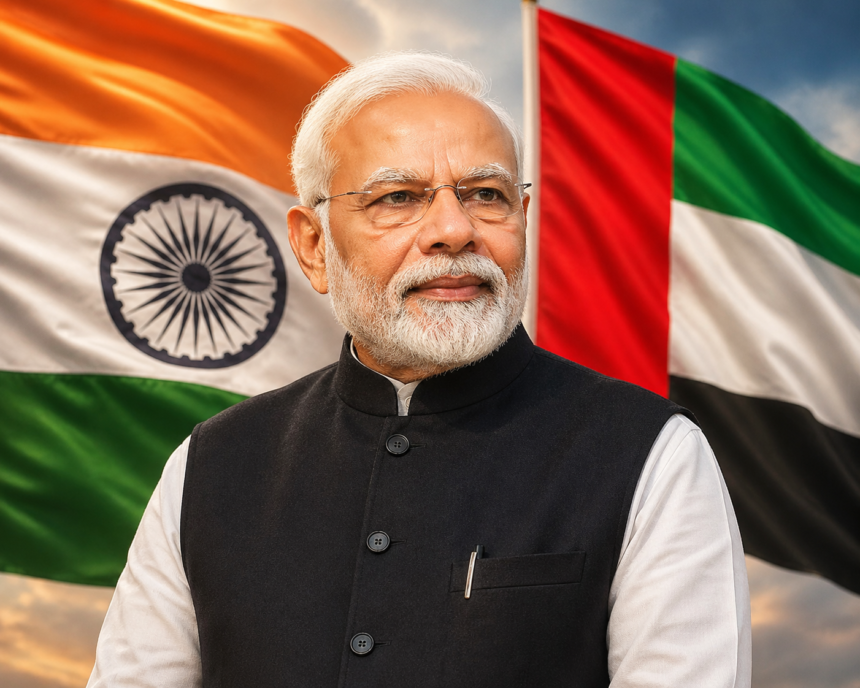
Artist’s Impression of Indian Prime Minister Narendra Modi
Modi and the UAE: A Strategic Partnership That Reached New Heights
In these last four decades, I have witnessed firsthand the remarkable transformation of relations between India and the United Arab Emirates. While the two nations have historically shared strong cultural and economic ties, it is fair to say that under Prime Minister Narendra Modi and UAE President His Highness Sheikh Mohamed bin Zayed Al Nahyan, the relationship has entered a truly historic phase.
What makes this partnership unique is not merely diplomacy but the evident warmth, mutual respect and personal rapport between the two leaders. Prime Minister Modi has frequently referred to Sheikh Mohamed bin Zayed as a “trusted friend”, while the UAE leadership has consistently extended exceptional hospitality and respect during his visits. These personal bonds have translated into tangible outcomes that have benefited both nations and their peoples.
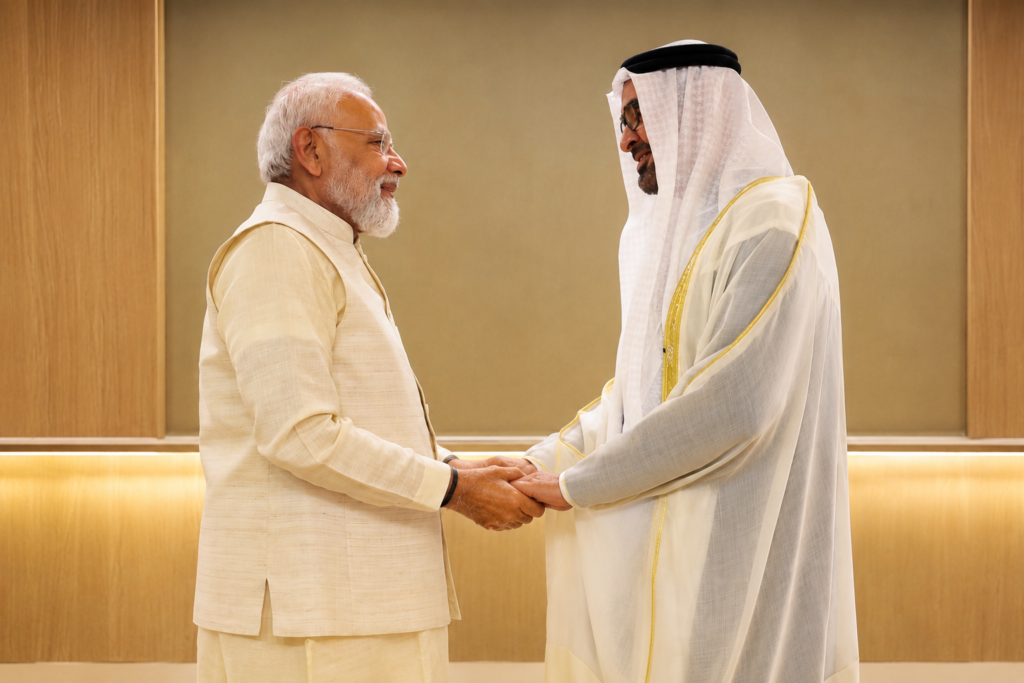
Indian Prime Minister Hon’ble Narendra Modi with UAE President His Highness Sheikh Mohamed bin Zayed Al Nahyan—————-picture courtesy WAM
Perhaps the most significant achievement has been the signing of the Comprehensive Economic Partnership Agreement (CEPA) in 2022. Since its implementation, bilateral trade has surged dramatically, with India-UAE trade crossing the landmark US$100 billion mark. The agreement has expanded opportunities for businesses, investors and entrepreneurs in both countries while strengthening the UAE’s position as one of India’s most important economic partners.
The partnership has extended well beyond trade. India and the UAE have deepened cooperation in energy security, food security, technology, defence, education, fintech, renewable energy and infrastructure development. Landmark initiatives such as local currency settlements, digital payment connectivity and the establishment of IIT Delhi-Abu Dhabi reflect a forward-looking relationship focused on innovation and future generations.
For the nearly four million Indians who call the UAE home, the strengthening of bilateral ties has been particularly meaningful. The Indian community enjoys immense respect in the Emirates, while the UAE continues to be one of India’s closest partners in the Gulf region. Today, the India-UAE relationship stands as a model of how two nations can build a partnership based on trust, mutual benefit and shared ambition.
As Prime Minister Modi completes twelve years in office, the extraordinary evolution of India-UAE relations will undoubtedly be remembered as one of the defining foreign-policy achievements of his tenure. Together, Modi and Sheikh Mohamed bin Zayed have transformed a traditional friendship into a comprehensive strategic partnership that is shaping the future of both nations.
On behalf of the entire team at EmiratesReporter.com, we extend our heartfelt congratulations to Prime Minister Shri Narendra Modi on completing 12 successful years in office. We wish him continued success, good health, and many more years of dedicated service to the people of India.
About The Writer:
Our Consulting Editor, Advocate Anjana Bhatia D.I is an accomplished Indian Lawyer practicing in India and the UAE. She has over 25 years of experience in Law – Litigation, Corporate, Civil, Criminal, Mediation as well as registered with DIFC Wills and Probate Registry. She provides legal solutions to clients globally with strategic results.