



Dubai, UAE – A new report by JLL reveals that global smart cities, including Dubai, can unlock billions of dollars in economic value by treating their technology initiatives as a serious, high-performing investment class, rather than an experimental innovation spend. When evaluated with the same rigorous financial metrics as infrastructure or real estate, such as Net Present Value (NPV), Internal Rate of Return (IRR), and payback periods, smart city projects prove to be a compelling investment proposition and a high-performing asset class.
The report, “Smart cities, smart investments?”, establishes a direct link between technology deployment, financial returns, and city-wide economic growth. A key finding is that the largest economic benefits come from “GDP boosters”, or the indirect economic impacts from deployed technology. These have a multiplier effect from gains in commerce, development, health, productivity, and sustainability. These transform smart city technology from an operational upgrade to functioning infrastructure.
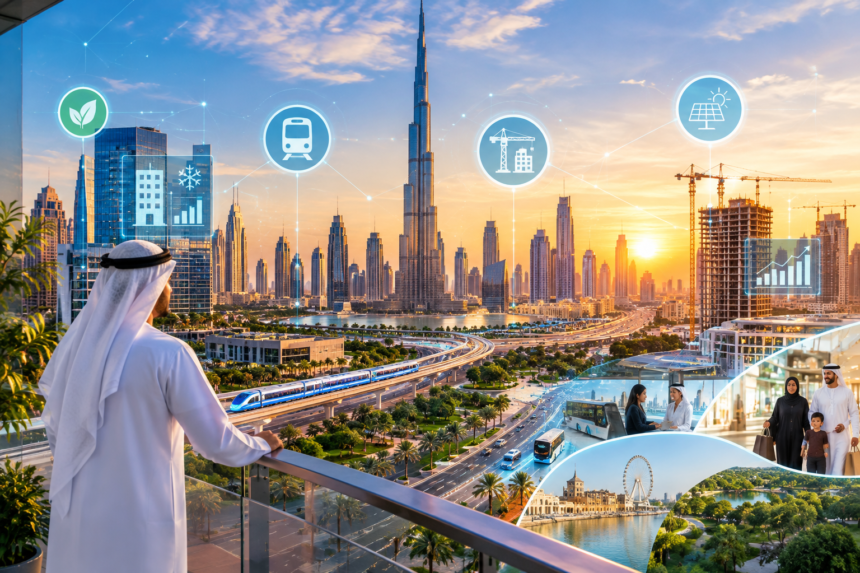
Crucially, the report finds that returns are hyper-local. A one-size-fits-all approach fails, as the greatest returns are unlocked when technology is chosen to solve a city’s unique challenges. In Dubai, for example, the analysis identifies three top-priority use cases. These include AI energy analytics to cool buildings more efficiently, seamless transit options to save valuable workforce time, and smart construction to drive efficiency in infrastructure development.

Dr. Matthew Marson, Managing Director – EMEA & APAC, Technology Consulting at JLL, said: “Globally, the conversation around smart cities has been limited to their potential, framing these as a nice-to-have. Our data shifts that conversation to performance. The new study shows that smart technology generates measurable financial returns, can be deployed at scale, and solves real-world urban challenges, creating clear economic value for city planners, investors, and developers alike. Treating this technology as critical infrastructure transforms it into a mature asset class, backed by real, local demand that investors can act on.”
The report provides a detailed financial analysis for each technology use case in Dubai, a rapidly maturing center of trade, tourism, and financial services with a largely expatriate workforce. Topping the use case list is AI Energy Analytics, which delivers nearly $3.3 billion in Net Present Value (NPV) over a payback period of 5.8 years by optimizing HVAC systems in the city’s high-rise building stock. In Dubai’s predictably hot climate, saving 20% on electricity annually is a non-negotiable priority for the city.
Dubai’s high civilian-to-vehicle ratio reinforces the importance of Seamless Journeys technology as a critical part of the city’s plan to diversify transport options away from car dependence. This use case delivers $205 million NPV over a payback period of just 1.3 years. In a city where workforce wellbeing and urban liveability are prioritized, this directly contributes to the health and sustainability GDP boosters by reducing pollution and transport-driven emissions.
Another high-impact opportunity is Smart Construction technology, critical to keeping the city’s infrastructure flexible and aligned with Dubai’s 2040 Urban Master Plan. This use case delivers over $2 billion over a payback period of 6.8 years. By creating efficiencies in the construction industry, it creates a more liveable urban landscape with minimized embedded emissions and infrastructure that is designed to ease future congestion.
When applied to the specific challenges in each city, smart city technologies go beyond being a tactical, limited form of digitization and offer a means of stimulating economic growth and productivity gains at scale. Technology deployments can affect how efficiently buildings operate, how productively people contribute to an economy, how attractive a city is to investment, and how much unnecessary cost is removed from the wider system. Capitalizing on this multi-billion-dollar opportunity requires a fundamental shift in how regional stakeholders approach technology.
For city leaders, this means moving smart city budgets from IT procurement to core economic policy, backed by clear business cases and rigorous performance benchmarking. For regional investors, it opens up a resilient, institutional-grade asset class driven by concrete local demand. Developers and operators who integrate these intelligent technologies from the outset can secure the asset’s valuation, performance, and operational life.
To facilitate this shift, the report outlines a practical, five-step roadmap. It calls for leaders to define clear economic objectives and benchmark them against their city’s unique profile, ranging from energy costs to population density. The next step is to select a balanced portfolio of technology projects that serve both investor and civic interests, using pilots to validate financial returns and scalability. Finally, to ensure long-term success, cities must institutionalize these capabilities, embedding data analytics, strategic review, and smart city policymaking into their core operations.
Across the Middle East and Africa (MEA) JLL is a leading player in the real estate and hospitality services markets. The firm has worked in 35 countries across the region and employs over 1800 internationally qualified professionals across its offices in Dubai, Abu Dhabi, Riyadh, Jeddah, Al Khobar, Cairo, Casablanca, Cape Town, Johannesburg and Nairobi.
SOURCE: MEDIA RELEASE / SUPPLIED CONTENT WITH IMAGE; AI GENERATED IMAGE ALSO USED