


Editor-Recommended Article
Dubai, UAE- The much-anticipated Branded Residences Forum – now a key event at the Future Hospitality Summit – returns to FHS World this October with a new identity: FHS Living.
Taking place on Wednesday 1 October, FHS Living will cover all living asset classes including branded residences, student accommodation, senior living, serviced living, co-living, shared ownership, club concepts, mixed use, and hotels & resorts, with global leaders in the sector taking centre stage for an afternoon of debate, analysis and advice.
In the run up to FHS Living, co-located with FHS World, industry experts share their thoughts on the key factors driving this ever-growing asset class, how brands can differentiate themselves in the market, where the best investment opportunities are, and more.
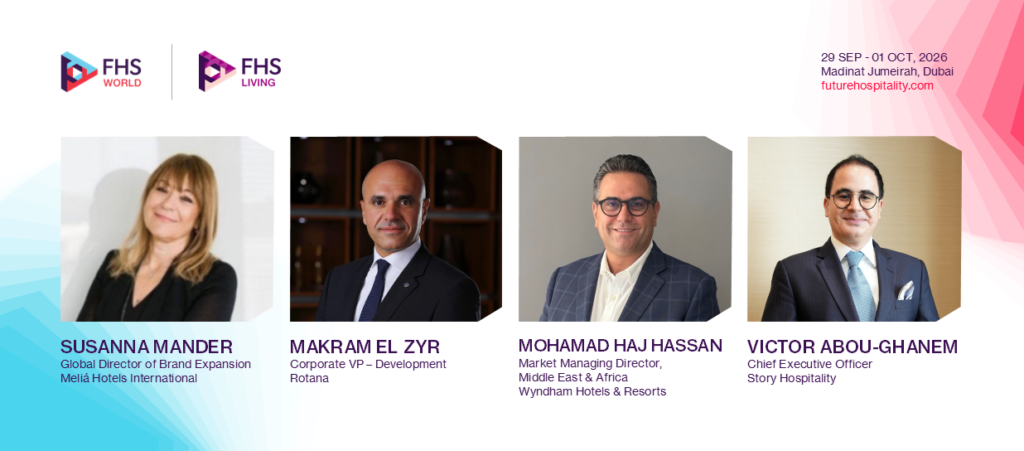
With input from Susanna Mander, Global Director of Brand Expansion, Meliá Hotels International; Makram El Zyr, Corporate Vice President – Development, Rotana;Victor Abou Ghanem – CEO, STORY HospitalityandMohamad Haj Hassan, Market Managing Director, Middle East & Africa, Wyndham Hotels & Resorts.
In recent years, branded residences have shifted from a niche to a mainstream asset class. What factors are driving this acceleration?
According to Susanna Mander, Global Director of Brand Expansion, Meliá Hotels International, the growth is not only financial – it’s emotional.
“People today are not just buying real estate; they are buying a way of living, a sense of belonging and a trusted experience,” she says. “The pandemic accelerated the search for flexibility, wellbeing and community. At the same time, owners and investors recognised that hospitality brands bring operational expertise, brand credibility and long-term asset stewardship, which translates into stronger value and resilience.
“For us, branded living is the natural evolution of hospitality: extending the relationship with our guests from a stay to a lifetime,” she added.
Makram El Zyr, Corporate Vice President – Development, Rotana believes that the shift is driven by a change in people’s expectations.
“Today’s buyers are not just looking for a place to live; they want quality, comfort, and peace of mind. They want good design, great service, and amenities that make their daily life easier, whether it’s wellness facility, a personal trainer, or a shared terrace where they can host friends and family. The idea of a home that takes care of you, the way a great hotel does, is becoming something people actively seek out rather than stumble upon,” he said.
The Middle East is among the world’s fast-growing regions for branded residences, with Saudi Arabia and the United Arabic Emirates a big draw for investors. What makes these markets so attractive?
Mohamad Haj Hassan, Market Managing Director, Middle East & Africa, Wyndham Hotels & Resorts, believes that KSA and the UAE are particularly attractive because they combine ambitious national development strategies, investor-friendly reforms, and strong demand from both local and international buyers.
“In Saudi Arabia, the transformation under Vision 2030 is creating entirely new destinations where hospitality and residential living are being developed together. Major projects such as The Red Sea project, and AMAALA are embedding branded residences into large-scale master plans. At the same time, regulatory reforms and evolving property ownership frameworks are opening the market further to international investors, while rising domestic wealth and lifestyle aspirations continue to drive demand,” he says.
“In the UAE, Dubai and Abu Dhabi have become global hubs for wealth migration and international investment. Thousands of high-net-worth individuals relocate to the country each year, attracted by economic stability, strong infrastructure, and investor-friendly policies. Branded residences have consistently achieved significant pricing premiums over non-branded units, reinforcing their appeal as both lifestyle and investment assets.
“Across both markets, developers are increasingly looking for partners who can bring credibility, distribution, and operational expertise. At Wyndham, we focus on supporting owners with global brand recognition, strong loyalty reach, and operational systems, while ensuring projects are delivered responsibly and in line with local policies and guidance,” he adds.
It’s a view shared by Victor Abou Ghanem, CEO at STORY Hospitality, who points out that Saudi Arabia and the UAE combine ambitious national tourism visions with deep local and international demand for high-quality real estate. The markets offer what branded residences need most: visionary master-planning, supportive regulation, global visibility, and a clientele that is both aspirational in lifestyle and sophisticated in its investment mindset.
“Demographically, these markets benefit from young, affluent populations with a strong appetite for real-estate investment, as well as established expatriate and international investor communities that understand the value of branded products. For many buyers, Riyadh, Jeddah, Dubai and Abu Dhabi now sit in the same investment conversation as Miami, Singapore or London, with the added appeal of tax efficiency in many cases and strong connectivity to Europe, Asia and Africa,” says Ghanem.
“From a development perspective, giga-projects and new coastal or urban districts in Saudi and the UAE are being designed around integrated lifestyles rather than standalone assets. That naturally favours branded residences, which bring international standards, governance and rental management into these emerging destinations.”
Is demand for branded residences being led more by lifestyle aspirations or by investors seeking yield and capital protection? How does the risk-return profile compare?
Makram El Zyr from Rotana says that it’s a combination of both, which is what makes the asset class so interesting.
“Some buyers are drawn to branded residences purely because of the lifestyle and the status that comes with it. It’s part of how they define themselves. Others are approaching it as a calculated investment, and the numbers support that view. Branded residences tend to sell at higher prices and can generate higher rental income than unbranded properties. The brand itself acts as a quality signal that protects value over time. So, you really do get the best of both worlds: a home you are proud of, and an asset that performs well,” he says.
Mohamad Haj Hassan at Wyndham echoes the view that demand is driven by both lifestyle aspirations and investment considerations, but points out that the balance varies across markets.
“Investor-led demand in the UAE is particularly strong,” he says. “The continued inflow of international capital and wealth migration has reinforced the appeal of branded residences as assets that combine lifestyle benefits with capital resilience and strong resale value.
“In Saudi Arabia, lifestyle aspirations play a more prominent role. As part of the wider social and economic transformation under Vision 2030, branded living is increasingly positioned as part of a broader lifestyle shift, offering residents access to high-quality services, amenities, and internationally recognised brands.”
He adds that from a developer’s perspective, branded residences often offer a balanced risk-return profile. Compared with traditional residential developments, they command stronger pricing and brand credibility, while compared with standalone hotels, they can diversify revenue streams and support earlier capital recovery through residential sales. The key is partnering with hospitality brands that bring operational discipline, systems, and long-term brand stewardship to protect the value of the development over time.
Owners and developers have a world of brands to potentially partner with, from globally-renowned, prestige names to local brands with cultural relevance. How do they get it right?
STORY Hospitality’s Victor Abou Ghanem says that brand selection should not be a beauty contest, but a strategic decision.
“A global name brings trust, systems, distribution and loyalty programmes, which are powerful drivers of demand. But in Saudi Arabia, the UAE and the wider region, success also depends on how well that brand understands local life: privacy, family gatherings, weekends, use of outdoor spaces, even how guests are welcomed,” he says.
“At STORY, we always ask three simple questions. Does this brand truly know how to run branded living, not just hotels? Does it resonate with the buyers we are targeting? And can it adapt design and service to our culture while staying true to its DNA and bringing high returns?
“When those three align, the project is on the right track.”
For Melià, the answer is balance. Susanna Mander says: “Global recognition provides confidence and distribution, but authenticity creates emotional connection and long-term differentiation.
“At Meliá, we always say that the brand must adapt to the destination, not the other way around. Whether in Europe, the Caribbean or the Middle East, our approach is to integrate local culture, gastronomy and design while maintaining global service standards.
“This is what transforms a real estate product into a meaningful living experience.”
With so many brands entering branded residences space, what truly differentiates one from another?
Should brands limit growth to protect exclusivity, or scale to maximise network value?
For Wyndham Hotels and Resorts, thereal differentiation today comes from the strength of the brand’s ecosystem. Developers increasingly look for partners who can provide distribution, technology platforms, operational expertise, and long-term governance rather than simply lending a brand name to a project.
“Global scale becomes valuable when it translates into real commercial benefits for owners. At Wyndham, our network of more than 8,300 hotels worldwide and the reach of Wyndham Rewards provide significant distribution and visibility. This helps support demand generation, marketing reach, and brand recognition across international markets,” says Mohamad Haj Hassan.
“At the same time, growth must be disciplined. Each project needs to deliver genuine value for owners and residents while maintaining the integrity of the brand. Our focus is always on long-term partnerships with developers, supporting projects through strong systems and responsible operations while continuing to prioritise the safety and well-being of guests, residents, and teams,” he adds.
Susanna Mander at Melià says: Logos do not create value — operational excellence and emotional engagement do. Our heritage of over 70 years in hospitality gives us a deep understanding of service, guest behaviour and community building. The ability to activate spaces, curate experiences and maintain long-term quality is what truly differentiates brands.
“Growth must be disciplined and purposeful. At Meliá, we focus on destinations where we can add value, protect owners and create lasting communities rather than simply expanding for scale.”
How important are mixed-use ecosystems (retail, F&B, culture, wellness) to the success of branded living in the Middle East? Can branded residences play a role in placemaking and destination creation?
According to Rotana,mixed-use environments absolutely add value, and increasingly, residents in this region expect them as a given.
Makram El Zyr says:“People want more than just a home; they want retail, dining, wellness, cultural experiences, and a genuine sense of community around them. That said, it is never about ticking every box for the sake of it. The right mix depends on the location, the available space, the design vision, and what actually makes sense for the people who will live there. The developments that get this right are the ones that feel like real, living destinations rather than just towers with a few added facilities.
“Branded residences have a real opportunity to lead in this space, particularly within larger masterplan strategies, where they can anchor a sense of place and bring a whole destination to life when they are planned with that ambition from day one,” he adds.
Victor Abou Ghanem from STORY says that in the Middle East, branded residences are rarely at their best as standalone towers. He believes that they thrive within well-planned mixed-use ecosystems that integrate hospitality, retail, F&B, culture, wellness, offices and public realm into a coherent place. For residents, this means convenience and lifestyle: everything from daily needs to special occasions is accessible within a short walk. For developers and cities, it means more vibrant, year-round destinations.
“Branded residences can play a powerful role in placemaking. Owners are long-term stakeholders rather than transient guests; they activate the community beyond peak tourist seasons, support local retail and F&B, and create a stable base of demand for services and amenities. When thoughtfully integrated into masterplans, branded living can anchor new waterfronts, urban regeneration projects or resort destinations, providing a premium residential layer that enhances the overall positioning,” he says.
In one sentence, what is the future of branded residences and branded living?
For Susanna Mander, it’s about creating authentic lifestyle communities where hospitality, culture, wellness and real estate come together to deliver long-term value for both people and places.
Makram El Zyr says that branded living is no longer a luxury add-on; it is fast becoming the benchmark that all quality residential development is measured against, and the brands that recognise that now will be the ones defining the next chapter of real estate in this region and beyond.
Victor Abou Ghanem believes the future is branded living: integrated, experience-driven communities where hospitality brands quietly choreograph the everyday rhythm of life, from wellness and workspaces to how people connect with their neighbours and the city around them.
And Mohamad Haj Hassan, says the future lies in the fusion of global hospitality brands with locally relevant lifestyle communities, evolving into mainstream residential destinations that deliver both long-term capital resilience and aspirational living across emerging and mature markets.
FHS World is happening at Madinat Jumeirah in Dubai, 29 September to 1 October 2026, under the theme Reinvest in our Future. FHS Living (formerly the Branded Residences Forum) is held within the summit, on the afternoon of 1 October.
SOURCE: Media Release / Supplied Content and Image. Based on information shared with EmiratesReporter.com / Editor-Recommended Article. Illustrative Image Also Used.