


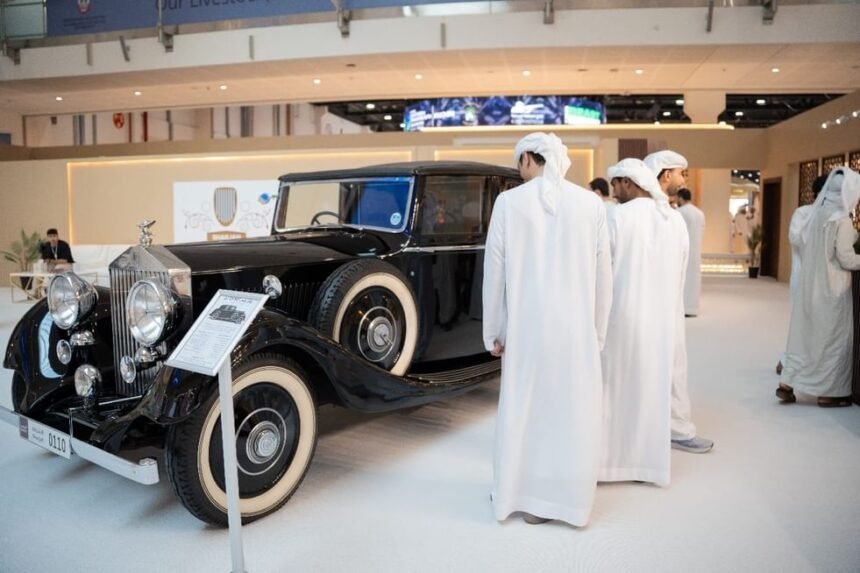
ABU DHABI, UAE (WAM) – Vintage Cars ADIHEX 2026 are stealing the limelight. Two vintage cars dating back nearly a century are drawing attention at the Abu Dhabi International Hunting and Equestrian Exhibition (ADIHEX) 2026, offering visitors a glimpse into a bygone era of automotive design and engineering.
A 1935 Rolls-Royce Phantom and a 1949 Riley RMC are among the highlights of the Sharjah Old Cars Club and Museum stand at the Abu Dhabi National Exhibition Centre (ADNEC), where the exhibition runs until 6th September.
The two vehicles, part of the Sharjah Old Cars Museum collection, have attracted considerable interest from vintage car enthusiasts and visitors drawn to heritage and rare collectibles.
Their artistic and engineering details reflect automotive design and manufacturing during the first half of the 20th century, while their display offers visitors an opportunity to learn more about vintage car culture and efforts to preserve it for future generations.
Dr Ali Ahmed Abu Al Zoud, Chairman of the Sharjah Old Cars Club, said the club’s participation reflects its efforts to strengthen its presence at major community and national events and bring vintage car culture to a wider audience.
“It also provides an opportunity to promote the Sharjah Old Cars Museum and introduce visitors to some of its most notable exhibits and rare vehicles of significant historical and cultural value.”
“We regard old cars as part of our cultural and social memory, rather than merely objects for display,” Abu Al Zoud said. “From this perspective, we are keen for our participation to carry an educational and informative message that connects the public with the history of these vehicles and the developments they witnessed in design, engineering and lifestyles over the decades.”
He said the strong turnout at the stand reflects growing interest in this form of heritage.
The participation also provides the club with an opportunity to engage with vintage car enthusiasts and owners, exchange expertise and introduce visitors to the services and programmes offered by the Club and Museum.
Vintage cars are generally defined by automotive historians and licensing bureaus as vehicles manufactured between 1919 and 1930, capturing a transformative golden era of mechanical innovation and cultural shift. Emerging directly after World War I, these machines represent the historic transition from basic, horseless carriages to fully integrated, functional passenger automobiles. This vibrant decade birthed iconic design elements that still captivate collectors today, such as prominent freestanding headlights, sweeping running boards, elegant spoked wheels, and highly decorative, exposed radiator caps. Engineering during this period advanced rapidly, introducing drivers to standard modern necessities like four-wheel braking systems, overhead-cam engines, automatic starters, and enclosed cabin structures that protected passengers from harsh weather. Beyond their mechanical specifications, vintage cars serve as rolling time capsules that vividly mirror the roaring twenties, symbolizing unprecedented economic prosperity, newfound social freedom, and the rapid industrialization of global manufacturing.
Owning and maintaining these antique vehicles requires specialized mechanical knowledge, a deep respect for historical preservation, and a passion for sourcing rare, period-correct components. They are rarely driven as primary transportation today, instead taking center stage at specialized concours d’elegance exhibitions, historical parades, and dedicated museum collections. Ultimately, a true vintage car is much more than an assembly of steel, wood, and rubber; it stands as a monument to early human ingenuity, marking the precise moment when the automobile permanently reshaped modern society, transformed global geography, and captured the collective human imagination. Several countries are world-famous for their vintage and classic cars, distinctively split between manufacturing giants with rich engineering legacies and living time capsules where historic vehicles are preserved out of pure necessity.
NEWS AND IMAGE COURTESY: WAM NEWS (www.wam.ae)