



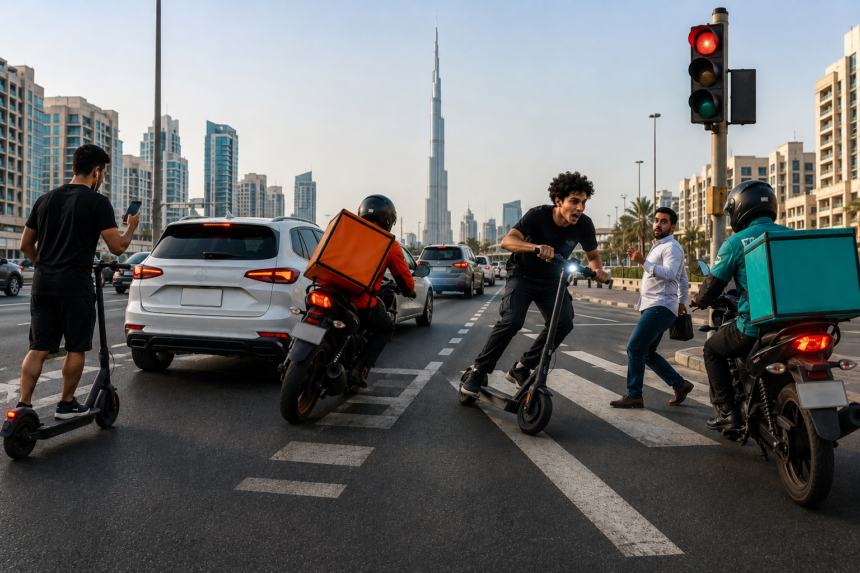
Fatal Risks, Massive Fines & Tough New Rules Everyone Must Know

By Advocate Anjana Bhatia D.I, Consulting Editor, EmiratesReporter.com
Dubai, UAE- As e-scooters, electric bikes, and delivery motorcycles rapidly become a common sight across UAE roads, concerns over reckless riding, traffic violations, and road safety risks are growing among motorists and authorities alike. From riders weaving dangerously through traffic to serious accidents involving pedestrians and vehicles, the issue has sparked tougher enforcement, stricter regulations, and widespread public debate. Amid increasing crackdowns, fines, and safety campaigns across the emirates, our Consulting Editor Advocate Anjana Bhatia D.I answered some of the most important and concerning questions about e-scooters and delivery bikes.
E.R- With the rapid rise of e-scooters, electric bikes, mini motorbikes, and delivery motorcycles on UAE roads, what are the current laws and regulations governing their use? What safety measures are mandatory to protect both riders and other motorists?
ADV. ANJANA BHATIA D.I- The UAE has introduced strict regulations for e-scooters, electric bikes, and delivery motorcycles to improve road safety. Riders must use designated lanes and approved roads, while highways and high-speed roads remain prohibited for such vehicles. Riders must generally be at least 16 years old, and individuals without a valid UAE or recognized international driving license are required to obtain an RTA e-scooter permit by completing an online safety course. Helmets, lights, reflective gear, and functioning brakes are mandatory in many emirates, particularly in Dubai and Abu Dhabi. Delivery riders are also subject to lane restrictions and traffic safety regulations enforced by the RTA and police authorities.
E.R- UAE roads are designed for smooth, high-speed traffic flow due to the country’s world-class infrastructure. In the event that an e-scooter or bicycle suddenly enters the path of a fast-moving vehicle and a serious accident occurs, how do police and authorities determine responsibility? What legal and financial consequences could both the car driver and the rider face?
ADV. ANJANA BHATIA D.I- In accidents involving e-scooters or bicycles, UAE authorities assess responsibility based on the circumstances of the incident, including road usage, traffic violations, speed, and rider behavior. If an e-scooter or bicycle rider suddenly rider enters a prohibited road or travels recklessly, liability may fall partly or fully on the rider for the collision. However, motorists may also face legal consequences if speeding, distracted driving, or negligence contributed to the accident. Depending on the severity of the accident, both parties may face fines, black points, insurance claims, compensation liability, and in serious cases, criminal investigation may also be initiated under UAE traffic and penal laws.
E.R- It is increasingly common to see e-scooter and bicycle riders travelling against the direction of traffic or using roads in unsafe ways. What laws are in place to curb such dangerous practices, and what penalties or fines can violators face?
ADV. ANJANA BHATIA D.I- UAE traffic laws strictly prohibit e-scooter and bicycle riders from travelling against traffic, using highways, or riding recklessly between vehicles. Authorities have intensified enforcement measures in response to the growing number of unsafe riding incidents reported across Dubai, Abu Dhabi, and other emirates. Riders are required to follow traffic signs, designated lanes, and approved riding zones. In Dubai, riding against traffic or using prohibited roads may attract fines ranging from AED 200 to AED 500, while repeated or dangerous violations may result in immediate confiscation of the scooter or bicycle. Delivery motorcycle riders who violate newly introduced lane restrictions may additionally face permit suspension or disciplinary action by their employers or delivery platforms. Authorities have also increased roadside inspections and confiscation campaigns in areas where reckless riding behaviour has become common.
E.R- Many e-scooter riders and cyclists are seen without helmets, reflective jackets, lights, or other protective gear, creating risks not only for themselves but also for motorists. What steps are UAE authorities taking to address this growing safety concern?
ADV. ANJANA BHATIA D.I- UAE authorities have strengthened enforcement and awareness campaigns to address safety concerns involving e-scooter and bicycle riders operating without helmets, reflective jackets, lights, and other mandatory protective equipment. The RTA and Dubai Police have emphasized that helmets, reflective gear, front and rear lights, bells or horns, and functioning brakes are required under current safety regulations. Authorities have increased inspections in busy areas and shared mobility zones, with fines and confiscation imposed for repeated non-compliance. Public awareness campaigns and safety guidance through rental applications have also been expanded to educate riders on safe riding practices, particularly at night and on roads shared with fast-moving traffic.
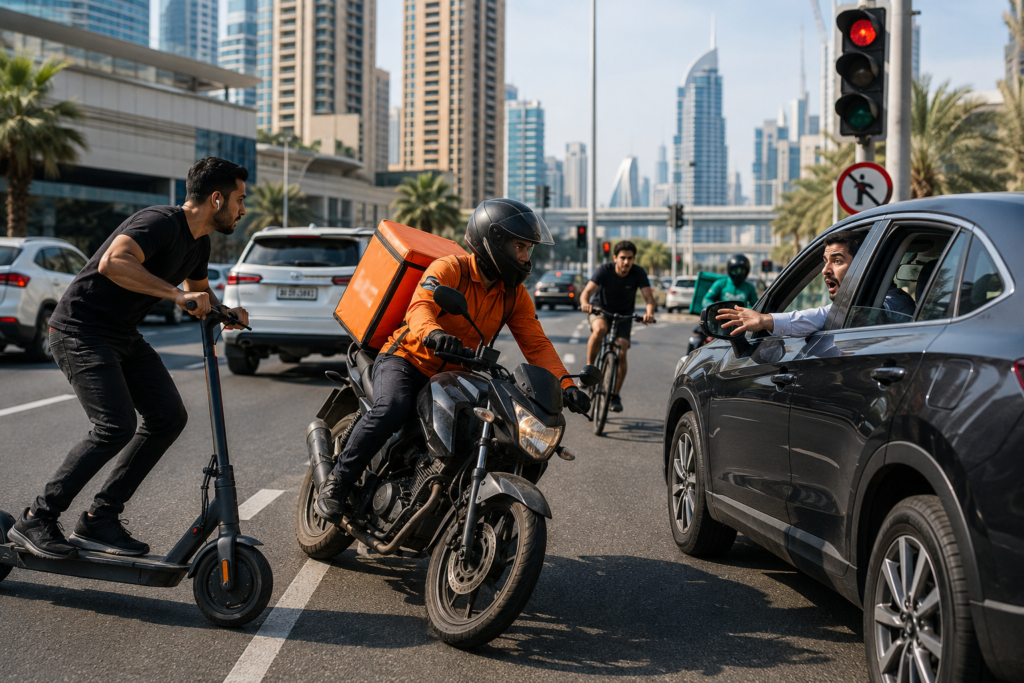
A.I GENERATED IMPRESSION
E.R- In situations where a delivery bike rider is weaving/zig zagging dangerously between lanes at a traffic signal and accidentally damages a stationary vehicle, for example, by hitting it with the bike handle or delivery box, what rights does the car owner have? What penalties or compensation procedures apply to the rider involved?
ADV. ANJANA BHATIA D.I- If a delivery motorcycle rider damages a stationary vehicle while weaving dangerously between lanes, the car owner has the right to file a police complaint and obtain an official accident report. Authorities will determine fault based on available evidence, including CCTV footage traffic violations, witness statements, vehicle damage, and traffic violations committed by the rider. Where the delivery rider is found responsible, compensation for damages is usually recovered through the rider’s or delivery company’s insurance coverage. The rider may additionally face fines, black points, permit suspension, or disciplinary action by the employer or delivery platform, particularly in light of recent enforcement efforts aimed at improving delivery rider safety and reducing accidents involving motorcycles on congested roads.
E.R- Under what circumstances can authorities confiscate e-scooters, bicycles, or delivery motorcycles permanently? Are there discussions about stricter regulations or possible future restrictions on their use in certain areas?
ADV. ANJANA BHATIA D.I- UAE authorities have the power to confiscate e-scooters, electric bicycles, and delivery motorcycles for repeated traffic violations, reckless riding, use in prohibited areas, or operating vehicles that do not meet approved technical specifications. Modified or high-powered electric bikes that cannot legally be registered for road use may also be seized. Authorities in Dubai and Sharjah have increased enforcement campaigns targeting unsafe riding, highway use, and non-compliance with permit and safety requirements. Repeated offences or unpaid fines may result in prolonged impoundment or permanent confiscation. Recent developments, including stricter lane rules, helmet enforcement, and proposed registration measures, indicate a move toward tighter regulation and possible future restrictions in high-risk or densely populated areas.
E.R- Teenagers are increasingly attracted to e-scooters and electric bikes, often without fully understanding the risks involved. How can parents educate and protect their children from unsafe riding habits and potential accidents?
ADV. ANJANA BHATIA D.I- To protect teenagers, parents should enforce a strict “no helmet, no ride” policy, ensuring headgear is always properly fitted and fastened. It is essential to treat these devices as motorized vehicles rather than toys, focusing on building muscle memory for controlled braking and requiring riders to dismount at all pedestrian crossings. Prohibiting “distracted riding” such as using headphones or mobile phones and setting firm boundaries against riding on high-speed roads or in low-light conditions are critical steps. By modeling safe behavior and emphasizing situational awareness, parents can significantly reduce the risk of accidents.
E.R- Many delivery riders work under intense time pressure to meet deadlines. Do experts believe that unrealistic delivery targets and long working hours are contributing to reckless riding and road safety violations?
ADV. ANJANA BHATIA D.I- Experts emphasize that the current delivery service model creates a direct link between rigid time algorithms and reckless road behaviour. When riders face unrealistic deadlines and performance penalties, the pressure often forces them to prioritize speed over safety, leading to violations like jumping red lights or riding on sidewalks. Additionally, long working hours cause physical and cognitive fatigue, significantly impairing judgment and reaction times. To address these risks, specialists suggest that systemic changes, such as relaxing delivery windows and implementing mandatory rest periods are more effective than individual training alone.
E.R- Are there designated roads, lanes, or zones in the UAE where e-scooters and bicycles are prohibited? How aware are riders of these restrictions, and are enough awareness campaigns being conducted?
ADV. ANJANA BHATIA D.I- e-scooters and bicycles are strictly prohibited on highways and roads with speed limits exceeding 60 km/h, as well as on dedicated jogging tracks and pedestrian-only sidewalks. To minimize accidents, they are also banned from certain high-speed professional cycling tracks. While the RTA and ITC conduct extensive multilingual awareness campaigns, a gap remains among riders who lack formal driving licenses. To bridge this, authorities now require an online safety course and a mandatory permit for e-scooter users in Dubai, ensuring they are educated on restricted zones and road signs before riding.
E.R- In the event of a fatal or life-altering accident involving an e-scooter or delivery bike, how do UAE courts typically deal with issues of negligence, insurance liability, and compensation?
ADV. ANJANA BHATIA D.I- UAE courts handle severe accidents involving e-scooters or delivery bikes by combining federal civil laws with Sharia principles. A court-appointed expert typically determines the degree of negligence, and if both parties are at fault, liability is split proportionally. While delivery bikes are covered by mandatory commercial insurance, the lack of compulsory insurance for e-scooter riders often results in personal financial liability for damages. In fatal cases, courts mandate the payment of 200,000 AED in “Diyat” (blood money), while life-altering injuries are compensated via Arsh (legal compensation for physical injuries) with payments calculated based on the severity and permanence of the disability.
E.R- With the increasing number of e-scooters and delivery bikes on the roads, do traffic experts believe the UAE needs stricter licensing, mandatory training programs, or registration systems for riders?
ADV. ANJANA BHATIA D.I- Traffic experts believe that as e-scooters and delivery bikes become more common, the UAE needs tougher rules to keep everyone safe. While online permits are a good start, specialists recommend mandatory in-person training so riders can actually practice emergency stops and safe turns. They also suggest a formal registration system, like license plates for all scooters, to make it easier to hold reckless riders accountable. By making these vehicles a part of the official national traffic system, authorities can ensure the same high safety standards are followed across every emirate.
E.R- What message are UAE authorities trying to send through ongoing crackdowns, inspections, and fines related to reckless e-scooter and delivery bike usage?
ADV. ANJANA BHATIA D.I- UAE authorities are using these crackdowns to signal a shift in the legal status of e-scooters and delivery bikes, treating them as motorized vehicles governed by Executive Council Resolution No. (13) Of 2022 and Decree No. 30. By enforcing fines up to 300 AED for dangerous riding and setting impound release fees as high as 50,000 AED, officials are prioritizing public safety over convenience. The introduction of mandatory number plates and the Personal Mobility Monitoring Unit aims to eliminate rider anonymity, while new parental liability laws ensure that guardians are held legally responsible for violations committed by minors. Ultimately, these measures support a “Zero Fatalities” strategy, reclassifying modified high-speed scooters as unlicensed vehicles to ensure strict technical compliance across the emirates.
“The above is a general overview; outcomes differ from case to case and are subject to the discretion of the concerned authorities. Illustrative Images used are made with A.I”
Our Consulting Editor, Advocate Anjana Bhatia D.I is an accomplished Indian Lawyer practicing in India and the UAE. She has over 25 years of experience in Law – Litigation, Corporate, Civil, Criminal, Mediation as well as registered with DIFC Wills and Probate Registry. She provides legal solutions to clients globally with strategic results.
ADVOCATE ANJANA BHATIA D.I CAN BE CONTACTED AT-
Mobile: +971505944896
Website: www.ajureadvocates.com
Email- anjana@ajureadvocates.com, editor@emiratesreporter.com