



By Advocate Anjana Bhatia D.I, Consulting Editor, EmiratesReporter.com
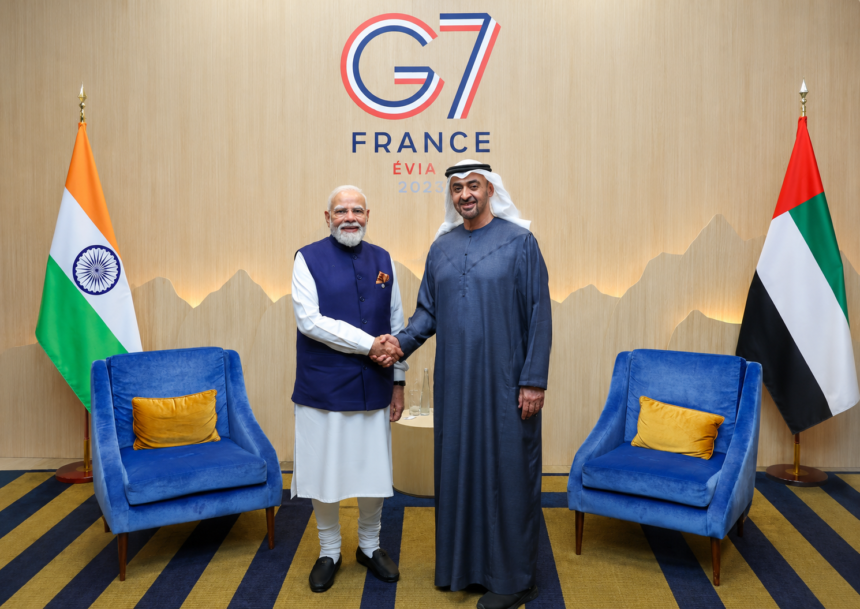
Dubai, UAE- The meeting between Indian Prime Minister Narendra Modi and UAE President H.H. Sheikh Mohamed bin Zayed Al Nahyan on the sidelines of the G7 Summit in Évian-les-Bains, France, may have lasted only a short time, but its significance extends far beyond a routine diplomatic engagement. In many ways, it reflected the growing strategic importance of the India-UAE partnership at a time when the world is navigating geopolitical uncertainty, energy security concerns, and shifting economic alliances.
The 2026 G7 Summit, hosted by French President Emmanuel Macron from June 15 to 17 in Évian, brought together leaders of the world’s seven major advanced economies: the United States President Donald Trump, United Kingdom Prime Minister Keir Starmer, Canadian Prime Minister Mark Carney, German Chancellor Friedrich Merz, Italian Prime Minister Giorgia Meloni, Japanese Prime Minister Sanae Takaichi, and French President Emmanuel Macron. The European Union was represented by European Council President António Costa and European Commission President Ursula von der Leyen. India attended as an invited partner country alongside several other key emerging and regional powers.
Against this backdrop, the Modi–Mohamed bin Zayed meeting stood out because it highlighted a relationship that has evolved from a traditional energy partnership into a comprehensive strategic alliance. According to India’s official statement, this was the third meeting between the two leaders in 2026 alone, underlining the frequency and depth of engagement between New Delhi and Abu Dhabi. The leaders reviewed cooperation in technology, trade, investment, energy, and defence while also exchanging views on regional and global developments.
The timing of the meeting is particularly important. The Middle East has experienced heightened tensions over the past year, while global markets remain sensitive to developments around the Strait of Hormuz, one of the world’s most critical energy corridors. Both leaders emphasized the importance of dialogue, diplomacy, respect for sovereignty, and uninterrupted maritime trade through the Strait of Hormuz. Such a message carries weight because India is one of the world’s largest energy consumers, while the UAE remains one of its most trusted energy and investment partners.
Economically, the partnership has become one of the fastest-growing in the world. The UAE is among India’s top trading partners and a major source of investment, while India remains a crucial market and talent hub for the Emirates. Their cooperation now spans renewable energy, digital infrastructure, artificial intelligence, logistics, food security, fintech, and defence manufacturing. The discussions at Évian reinforced the idea that both countries see each other not merely as regional partners but as long-term strategic stakeholders in each other’s growth stories.
The meeting also demonstrated the rising global profiles of both leaders. At a summit dominated by discussions on Ukraine, artificial intelligence, energy security, trade imbalances, and Middle East stability, India and the UAE positioned themselves as pragmatic voices advocating dialogue, connectivity, and economic cooperation. Their engagement reflects a broader trend in international affairs: the growing influence of middle powers that can bridge regions and help shape global conversations.
Perhaps the most important takeaway is that the India-UAE relationship is no longer driven solely by economics. It is increasingly becoming a strategic pillar linking South Asia, the Gulf, and the wider global economy. Prime Minister Modi’s invitation to Sheikh Mohamed bin Zayed to attend the BRICS Summit later this year further signals New Delhi’s desire to deepen this partnership across multiple international platforms.
In a world marked by fragmentation and uncertainty, the Modi–Mohamed bin Zayed meeting at the G7 Summit delivered a simple but powerful message: India and the UAE intend to remain close partners in shaping the economic and geopolitical future of their regions and beyond.