




Freedom of Expression or Public Outrage? Legal Expert Weighs In on Ranveer Singh Debate

By Advocate Yugal Anjana Bhatia, Bombay High Court, Mumbai, India
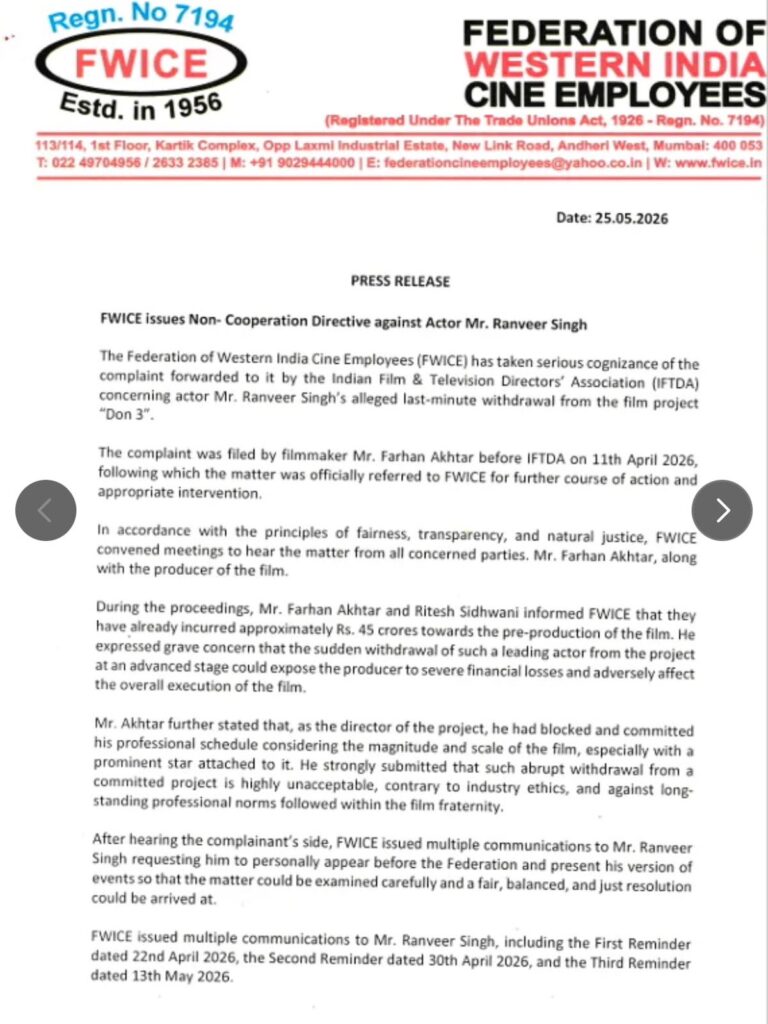
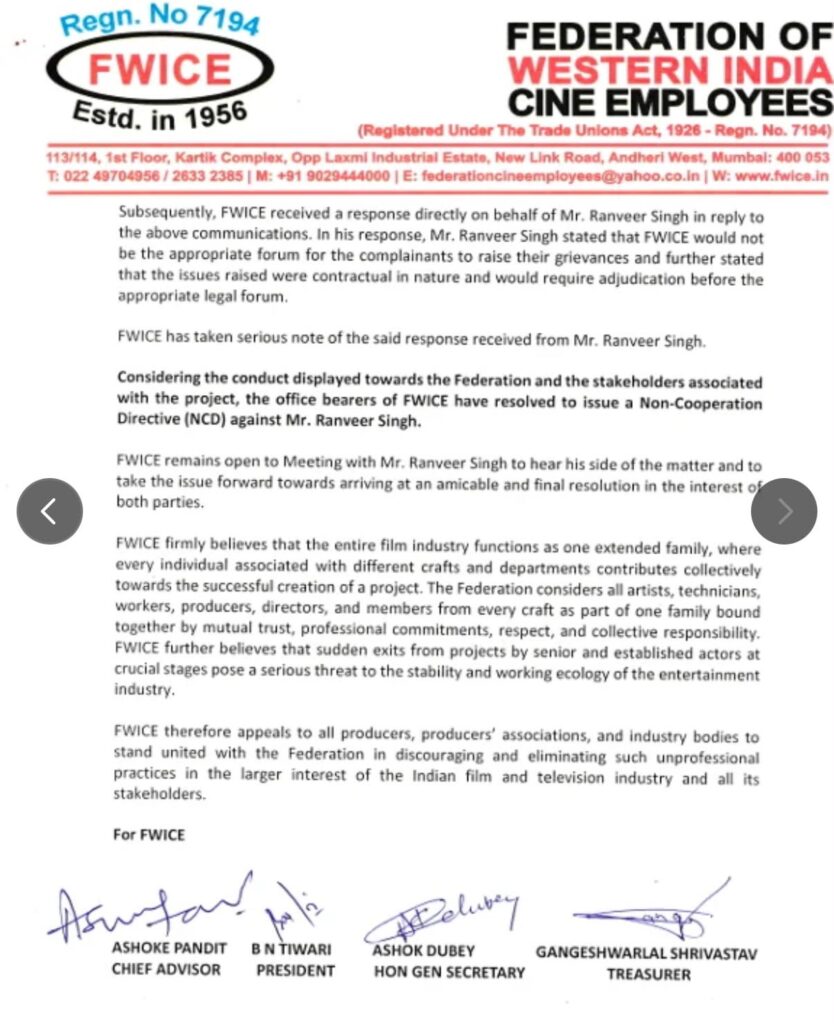
Mumbai, India, 26 May 2026: This legal article is based on the press release dated 25 May 2026 by Federation of Western India Cine Employees and examines the Non-Cooperation Directive dated 25 May 2026, which is effectively a professional ban imposed on actor Mr. Ranveer Singh by the Federation of Western India Cine Employees (FWICE). The directive stems from a complaint raised and filed by the filmmaker, Mr. Farhan Akhtar, on 11 April 2026 concerning the film “Don 3”, alleging substantial pre-production losses amounting to approximately Rs. 45,00,00,000/- (Indian Rupees Forty Five Crores only). This article dissects the illegality of FWICE’s directive, outlines the robust legal remedies available to Mr. Ranveer Singh and clarifies the appropriate legal channels that Mr. Farhan Akhtar ought to have pursued for his contractual claims.
It is imperative to note that FWICE is a Trade Union and not a Court of Law or Judicial Authority. The Federation of Western India Cine Employees is a body registered under The Trade Unions Act, 1926. Its primary and lawful mandate is to regulate the conditions of employment and relations between its member-workmen and employers. It is fundamentally not a judicial, quasi-judicial or arbitral body. It possesses no statutory authority to adjudicate complex contractual disputes, determine liability for damages or impose punitive measures that curtail an individual’s fundamental right to practice their profession. Any such attempt is an act of overreach and is ultra vires its powers.
A professional ban or a non-cooperation directive can only be enforced if it arises from a specific, valid and legally enforceable contract between Mr. Ranveer Singh and the body imposing it. Unless Mr. Ranveer Singh has explicitly consented in a binding agreement to subject himself to FWICE’s jurisdiction for such disputes and has authorized it to debar him from working, FWICE has no legal standing or authority to interfere in his professional engagements. The internal by-laws of a trade union cannot supersede the Constitution of India or the Indian Contract Act, 1872.
The Non-Cooperation Directive issued by FWICE, which urges producers, directors and other industry stakeholders to refrain from working with Mr. Ranveer Singh, constitutes a clear case of tortious interference with business relations. By actively inducing the breach of existing and future contracts, FWICE exposes itself to legal action for causing economic loss and reputational damage to Mr. Ranveer Singh.
The collective call for a boycott against a specific professional by a dominant industry association like FWICE can be construed as an anti-competitive agreement under the Competition Act, 2002. Such actions limit and control the provision of services, create barriers to entry and stifle fair competition, making the directive assailable before the Competition Commission of India (CCI).
Furthermore, it is pertinent to note that the Right to Livelihood under Article 19(1)(g) of the Constitution of India guarantees every citizen the fundamental right to practise any profession, or to carry on any occupation, trade or business. This right is the bedrock of economic freedom and can only be restricted by a “law” imposing “reasonable restrictions” as stipulated under Article 19(6).
Now I, Advocate Yugal Anjana Bhatia, must state that why the FWICE Directive is Unconstitutional in nature. Firstly, a directive, resolution or press release from a private body like FWICE is not “law” within the meaning of Article 13 of the Constitution of India. Therefore, it cannot impose any restriction, let alone a reasonable one, on a citizen’s fundamental rights. Secondly, a blanket, indefinite ban on a professional is inherently unreasonable, disproportionate, and punitive. It amounts to a complete negation of the right to livelihood, which is an integral part of the right to life under Article 21. Thirdly, the actions of FWICE are arbitrary and violate the principles of natural justice. The issuance of a ban without a fair hearing, without an opportunity to present a defence against a monetary claim, and without a reasoned, evidence-based decision is a flagrant violation of Article 14 of the Constitution of India, which guarantees equality and prohibits arbitrariness. Lastly, even if, for the sake of argument, FWICE were considered a body performing a public function, its directive would still fail the constitutional tests of reasonableness, proportionality, and procedural fairness. No authority, whether state or private, can operate in a manner that is manifestly arbitrary and destructive of fundamental rights.
Now the Legal Remedies Available to Mr. Ranveer Singh is a Civil Suit for Declaration, Injunction and Damages. Mr. Singh can institute a civil suit in the competent civil court for Declaration stating that the directive is illegal, non-binding, and unenforceable in nature. Additionally, Mr. Singh can seek reliefs of a Permanent Injunction to restrain FWICE from interfering with his current and future professional contracts and business opportunities and simultaneously seek Substantial Damages for loss of reputation (defamation), loss of income from cancelled or postponed projects, and mental anguish caused by the unlawful directive. Also, Suit for Defamation can be filed by Mr. Singh due to the public press release, which portrays Mr. Ranveer Singh in a negative light and harms his professional standing, provides strong grounds for a civil suit for defamation, seeking monetary damages for the injury to his reputation.
Other than the above, Mr. Singh can complaint before the Competition Commission of India under the Competition Act, 2002, arguing that FWICE and its members are engaging in an anti-competitive agreement by collectively boycotting a service provider, thereby abusing their dominant position and causing an appreciable adverse effect on competition.
The Correct Legal Path for Mr. Farhan Akhtar was and still is to adjudicate the Damages caused to him before a Judicial Authority or Court of Law. The claim of Rs. 45,00,00,000/- (Rupees Forty Five Crores only), whether for liquidated damages or unliquidated losses, is a civil dispute arising from an alleged breach of contract. Such claims require judicial determination based on evidence. FWICE is not the appropriate forum for such adjudication. Mr. Farhan Akhtar and the producer, Mr. Ritesh Sidhwani, cannot use the extra-legal pressure of an industry body to recover alleged dues.
The proper and correct Legal Recourse and only enforceable course of action for the filmmakers was and is firstly to file a Civil Suit for recovery of damages before the competent Civil Court. In court, they would bear the burden of proving the existence of a contract, the breach by Mr. Singh, and the quantum of loss suffered as a direct result of the alleged breach. They would need to substantiate the Rs. 45,00,00,000/- (Rupees Forty Five Crores only) figure with audited accounts, contracts, forensic accounting and other evidence. Alternatively, if the contract between the parties contains an arbitration clause, they must invoke arbitration to have the dispute adjudicated by a mutually appointed arbitral tribunal.
Any attempt to bypass these established legal processes by resorting to coercive measures through an industry association is an abuse of process and legally untenable. The directive by FWICE looks like an attempt by a private body to create a parallel, and illegal, system of justice.
Disclaimer:
“The Author of this analysis, which is done as per Indian Law System, is Advocate Yugal Anjana Bhatia, Practising at Bombay High Court, Mumbai, Maharashtra, India. The views expressed are solely of Advocate Yugal Anjana Bhatia. As claimed by Advocate Yugal Anjana Bhatia, the views, analyses, and commentary expressed in this article by him are strictly confined to Indian laws and the Indian cinema industry only. The content is intended solely for educational and informational purposes and bears no relevance, reference, or relation, either direct/indirect or implied, to any individual, public official, corporate entity, or organization within the United Arab Emirates (UAE). Nothing contained herein by the writer/author should be construed as legal advice or as commentary on the laws, regulations, or socio-cultural landscape of the UAE. This analysis is purely based on the news and a reaction by an advocate from India about Ban on Actor Ranveer Singh by Mumbai Film Industry.”