




By Rajni Rani, Chief Editor, EmiratesReporter.com
As I am a devout parota lover in the UAE, this is a food story I could not resist telling. Over the years, parota has become much more than a favourite on my plate. It is comfort food, nostalgia and, for many of us in the UAE, a small but delicious part of the country’s wonderfully diverse food culture. From a simple parota with curry to the many creative ways it is now being enjoyed, this flaky favourite has certainly travelled a long way. And when a much loved classic gets a spicy new twist, it deserves a closer look.
Dubai, UAE- In the UAE, food is much more than what is served on a plate. It is also a reflection of the country’s multicultural character. Walk through almost any busy neighborhood in Dubai, Abu Dhabi or Sharjah and it is easy to see how different food traditions have found a place in everyday UAE life.
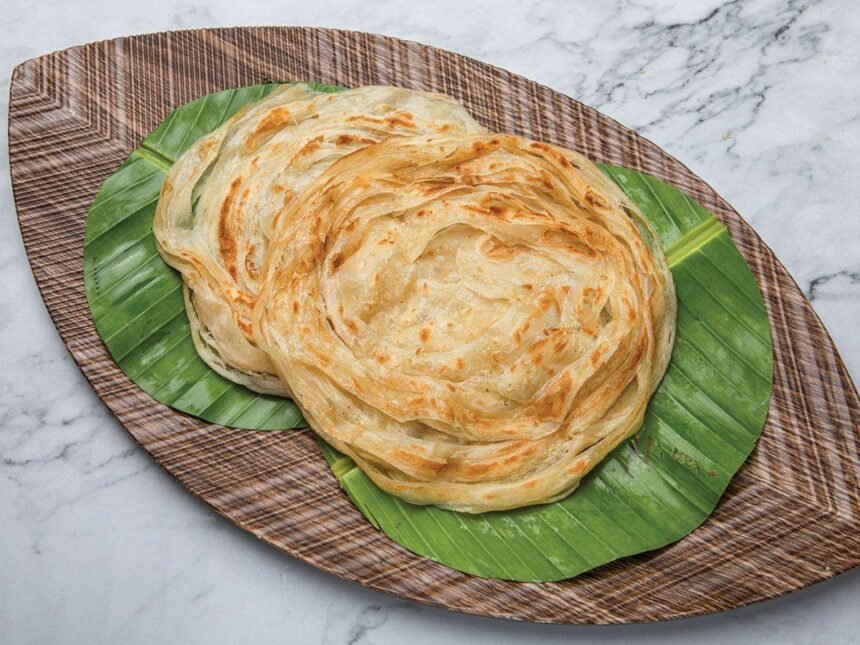
Among the many foods that have travelled with communities and gradually become familiar to a much wider audience is parota, the flaky, layered South Indian flatbread also widely known as parotta or porotta.
For many residents, particularly those with roots in Kerala and Tamil Nadu, parota is more than an accompaniment to curry. It is comfort food. It can mean a late night meal after work, a simple breakfast, a weekend family meal or a plate shared with friends at a neighbourhood restaurant.
And in the UAE, where South Indian cuisine has a strong presence, parota has become a familiar part of the everyday food landscape.
A flatbread with a fascinating history
The history of parota is not as straightforward as its simple appearance might suggest.
The South Indian parotta is different from the North Indian paratha, although the two belong to the same broad family of layered flatbreads. The Kerala style is generally made with refined wheat flour or maida and is known for its soft, flaky and layered texture. The dough is stretched, folded or coiled before being rolled and cooked, creating the characteristic layers.
The exact origin of the South Indian parotta remains debated. One theory suggests that its distinctive layered technique may have travelled to the Malabar Coast through historic maritime connections with West Asia. Kerala had longstanding trading links across the Arabian Sea, making the movement of ingredients, cooking techniques and food traditions possible over centuries.
What is clearer is the place parota eventually established for itself in South Indian food culture.
In Kerala, the Malabar parotta became closely associated with rich curries, meat dishes and street side food. In Tamil Nadu, different versions developed, including the famous kothu parotta, where the cooked bread is chopped on a hot griddle and combined with spices, gravy, eggs, vegetables or meat. Madurai and other Tamil cities became particularly associated with parotta culture and its many variations.
The story did not stop in India.
As South Indian communities travelled across the world, variations of the layered flatbread travelled with them. In Singapore it became known as roti prata, while Malaysia developed roti canai. These versions demonstrate how a familiar food can adapt to different places while retaining its basic identity.
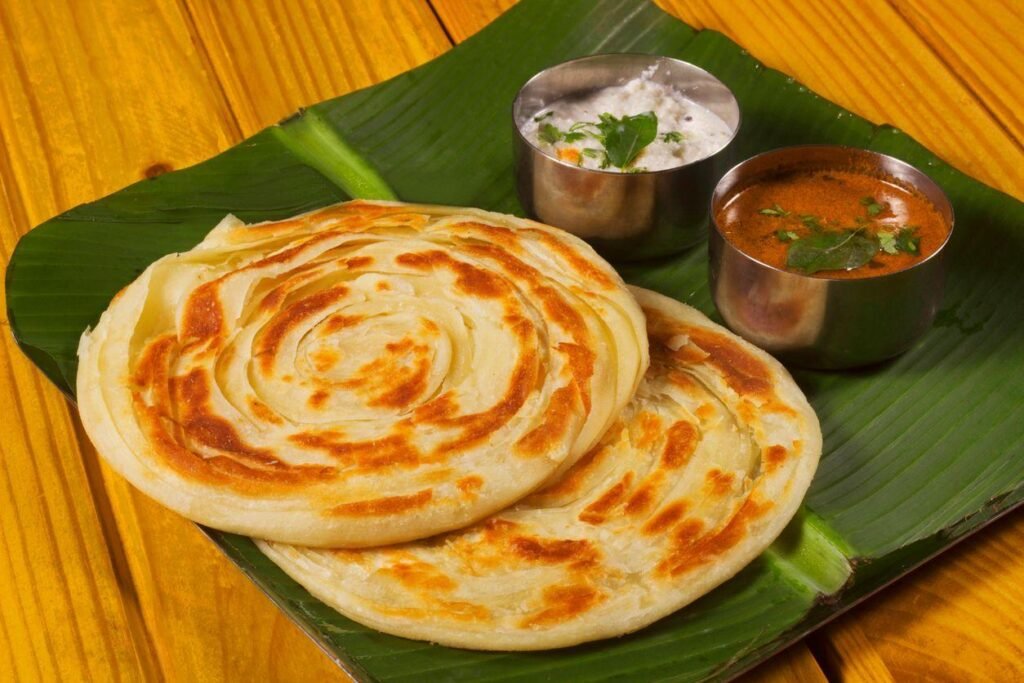
picture courtesy TALABAT.COM
Why parota works so well in the UAE
The UAE has provided another natural home for this food.
The country’s large South Asian community has helped bring regional Indian cuisines into everyday UAE dining. At the same time, the UAE’s diverse population has created an environment where dishes that were once strongly associated with particular communities can become widely enjoyed.
Parota is a good example.
It is inexpensive, filling and versatile. It can be eaten with vegetable curry, chicken, egg or meat dishes, or simply enjoyed with a dip. Its flaky texture also makes it different from many other flatbreads commonly found on the table.
Across UAE restaurants, especially those serving Kerala and South Indian food, parota continues to appear alongside familiar curries and traditional dishes. Recent food coverage in Abu Dhabi, for example, highlights Malabar parottas being served with Kerala favourites such as beef curry and other rich accompaniments.
The UAE therefore has not simply become a place where parota is available. For many residents, it has become part of the country’s broader everyday food culture.
From traditional parota to new flavours
Food culture, however, never stands still.
One of the interesting things about popular foods is that once they become familiar, they can also become a canvas for experimentation. The basic format remains recognisable, but new flavours, fillings and combinations can give it a completely different personality.
That is where the latest development from iD Fresh comes in.
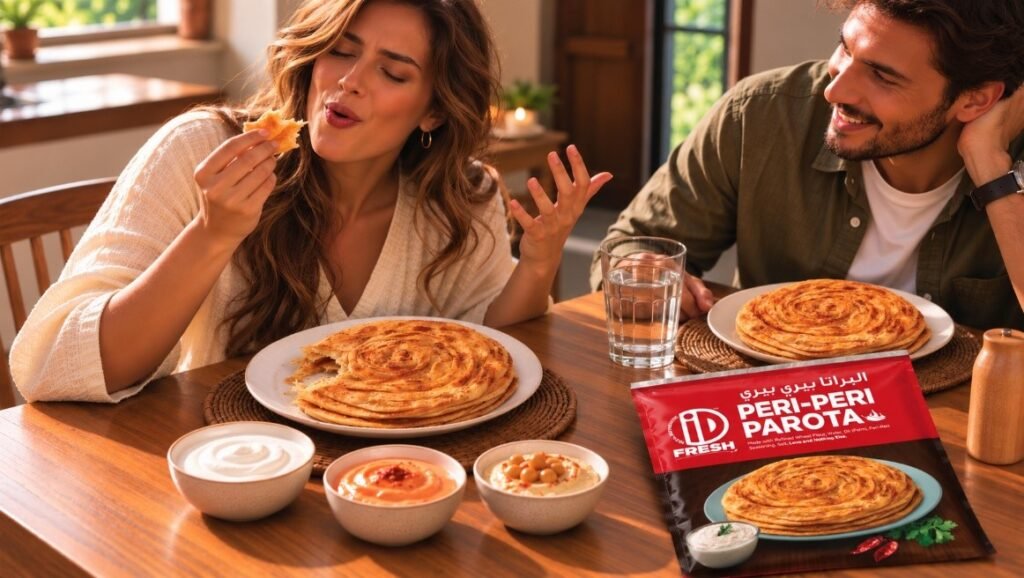
iD Fresh gives the familiar favourite a spicy twist
iD Fresh has introduced its Peri Peri Parota in the UAE, bringing together the familiar flaky texture of traditional parota with the bold flavour of peri peri seasoning.
The new variant gives consumers another way to enjoy a food they already know, while adding a distinctly spicy character to it.
According to the company, the Peri Peri Parota can be enjoyed straight from the pan, served alongside a meal or paired with dips and other accompaniments. It can also fit easily into different occasions, from breakfast and lunch to a quick evening meal.
The launch reflects a broader trend in the UAE food market: familiar foods are increasingly being presented in new formats and flavour combinations for consumers who enjoy trying something different without moving too far away from foods they already love.
For parota, this is another step in a journey that has already taken the humble layered flatbread from South India to kitchens and dining tables across the world.
And now, in the UAE, the traditional parota has a little more spice to bring to the table.
iD Fresh Peri Peri Parota
The iD Fresh Peri Peri Parota is available in a 240g pack priced at AED 7, according to the company.
It is available across selected hypermarkets in the UAE and through noon.
The product combines the flaky texture associated with traditional parota with peri peri seasoning, offering consumers a spicy variation of the familiar flatbread.
Founded in 2005, iD Fresh is a Bengaluru based company focused on fresh, ready to cook Indian foods. Its product range includes Idly and Dosa Batter, Parotas, Paneer, Vada Batter, Coffee, Chutney, Chapati and other products.
The company says its products are available across India, the UAE, the USA and the UK, with a focus on combining traditional Indian food with convenience.
iD Fresh Peri Peri Parota – As Per The Media Release / Supplied Content with iD Parota Image