



By Amit Kakkar, Managing Editor, EmiratesReporter.com
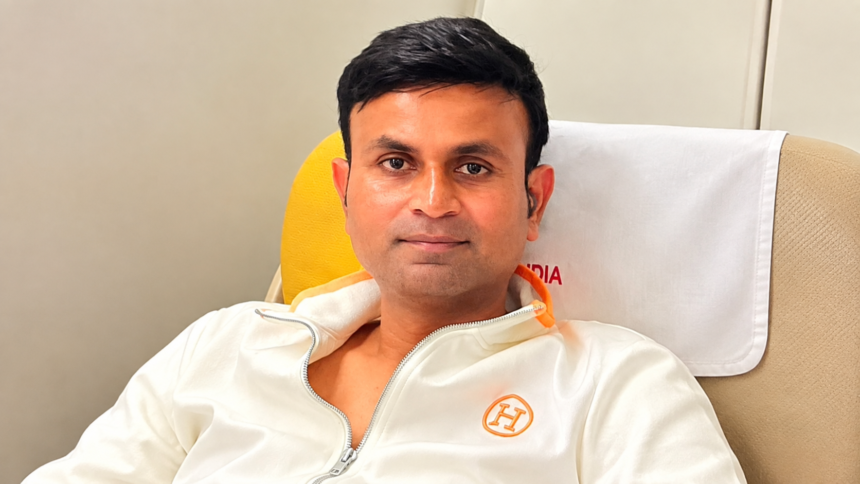
Dubai, UAE- For Santosh Davakhar, the journey to the Oscars has not been a conventional one. From working as a child labourer and paying his own school fees to becoming a filmmaker whose Marathi feature Gondhal has been selected as India’s official entry for the 99th Academy Awards, Davakhar’s story is as much about perseverance as it is about cinema. At 36, according to a February 2026 profile in The Indian Express, Davakhar now finds himself preparing to take a film deeply rooted in Maharashtra’s culture to one of the world’s most recognised cinematic platforms.
Born in Thane, Mumbai, Davakhar grew up in a modest family environment. He has spoken publicly about working from the age of 14, including loading and unloading goods at factories, earning around Rs 45 for a 12-hour shift. While his classmates were enjoying a more conventional school life, he was helping support himself and his education. He also coached younger children to pay his school fees. Despite the disruption caused by work, he completed his graduation and post-graduation in Economics.
His professional journey was not initially centred on cinema. Publicly available profiles describe him as a project consultant, former professor and social activist, with an IIM background. He eventually moved deeper into filmmaking, driven by a long-standing fascination with cinema. His formal filmmaking training was limited to a 45-day screenplay-writing course at the Film and Television Institute of India in 2019, making his subsequent achievements particularly notable in the context of his relatively unconventional entry into feature filmmaking.
Before Gondhal, Davakhar had already made his presence felt through short films. His film Party, made around 2013–14, dealt with malnutrition. His 2017 short Adnyat, a dialogue-free film exploring caste and identity, won the Silver Lotus for Best Cinematography in the Non-Feature Film category at the 64th National Film Awards. He also made Antar-19, a Covid-era film centred on a nurse balancing professional responsibilities and family life. His filmmaking has therefore repeatedly drawn from social issues and experiences around him.
Then came Gondhal, his first feature film as a director. The Marathi thriller takes its name from the traditional Gondhal ritual of Maharashtra and places the cultural form at the heart of a story involving desire, deception, relationships and escape. Set in rural Maharashtra, the film follows Suman, a woman trapped in an oppressive marriage, whose choices become increasingly dangerous as the Gondhal ritual unfolds. The cast includes Kishor Kadam, Ishita Deshmukh, Yogesh Sohoni and Nishad Bhoir, while veteran composer Ilaiyaraaja is associated with the film’s music.
Davakhar’s inspiration for Gondhal was also shaped by his exposure to international cinema. His short film Adnyat had travelled to Cannes, and during his time there he watched several films each day. He has explained that the experience made him think about how Indian cinema could present the country’s culture and traditions to an international audience. Rather than building his feature around familiar social themes, he wanted to take a story emerging from Maharashtra’s own cultural landscape to the world.
Gondhal was released theatrically in November 2025 and subsequently travelled through the festival circuit. At the 56th International Film Festival of India, Davakhar won the Silver Peacock for Best Director, with the IFFI jury recognising the film’s handling of tradition, form and narrative. He also received Best Director recognition at the Pune International Film Festival in 2026.
Interestingly, despite the renewed global attention, Gondhal is not currently available on major OTT platforms. As of September 19, 2026, no official OTT partner or digital premiere date had been announced. Davakhar has instead spoken about bringing the film back to audiences, including planned releases in Hindi, Malayalam and Kannada, while encouraging viewers to experience it in theatres.
The biggest chapter of Davakhar’s journey arrived in September 2026, when the Film Federation of India selected Gondhal as India’s official entry for the 99th Academy Awards in the Best International Feature Film category. The film was selected from 33 submissions. The announcement puts Davakhar and his team on the international awards circuit and makes Gondhal only the fourth Marathi-language film to be chosen as India’s official Oscar entry, following Shwaas, Harishchandrachi Factory and Court.
For Davakhar, the Oscar selection represents the culmination of a journey that began far away from film studios, in classrooms, factories, social work and a lifelong fascination with cinema. His story now moves from Maharashtra’s folk traditions to the international stage, with Gondhal carrying his interpretation of Indian culture into the 2027 Oscars campaign.
Santosh Davakhar’s achievement carries significance beyond one filmmaker and one film. With Gondhal selected as India’s official entry for the 99th Academy Awards, a Marathi-language film rooted in rural Maharashtra and its traditional Gondhal ritual is now being placed before the international film community. The film was selected from 33 submissions representing several Indian languages and filmmaking traditions, making the achievement relevant not only to Marathi cinema but to India’s wider regional film ecosystem.
For India, the selection is another reminder of the breadth of its cinematic identity. Indian cinema is not represented by Hindi films alone. India produces films in numerous languages, with stories emerging from different regions, communities, traditions and social realities. Gondhal brings one such distinctly Maharashtrian cultural setting to the international awards conversation. It is also only the fourth Marathi-language film to be selected as India’s official Oscar entry, following Shwaas, Harishchandrachi Factory and Court.
The significance for new-age filmmakers may be even more personal. Davakhar’s journey demonstrates that a filmmaker does not necessarily have to emerge from the conventional mainstream Bollywood system to reach one of cinema’s most visible international platforms. His path into filmmaking was unconventional, and Gondhal is his first feature film as a director. Its selection gives independent and regional filmmakers another example of how a story strongly connected to its own cultural environment can enter a national and international conversation.
The Oscars remain an extremely competitive process, and Gondhal is currently India’s official submission.
The 99th Academy Awards are scheduled for March 14, 2027.
There is also a wider message for filmmakers outside India. In an increasingly global film environment, audiences can connect with stories precisely because they are rooted in a particular place and culture. Gondhal does not have to remove its Marathi identity to enter an international arena. Instead, its cultural setting becomes part of what distinguishes it.
For young filmmakers watching Davakhar’s journey, the development can therefore be viewed as an encouragement to explore stories close to home, local traditions, regional histories, ordinary people and culturally specific experiences while presenting them with cinematic ambition. The international journey of Gondhal shows how a story born in rural Maharashtra can now become part of a conversation extending far beyond Maharashtra.
Davakhar himself has described the Oscar selection as carrying a major responsibility because the team is representing India. His comments also underline that the next stage is not simply about celebrating the selection but about the hard work of taking the film before Academy voters and an international audience.
For Indian cinema, therefore, the Gondhal moment is about representation as much as recognition. It places Marathi cinema, regional storytelling and an unconventional filmmaker on the same international road travelled by generations of Indian filmmakers. And for filmmakers around the world working outside established systems, Davakhar’s journey offers a simple cinematic lesson: a story can begin locally without limiting how far its journey can go.
EXCLUSIVE INTERVIEW OF THE FILMMAKER COMING SOON !!!!