



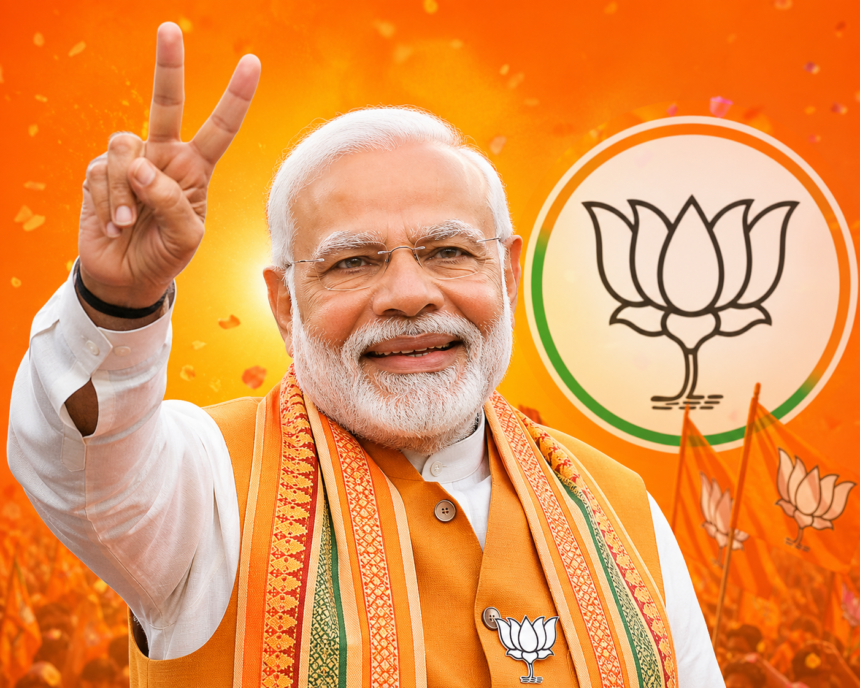
SAFFRON WAVE DELIVERS TRIPLE STATE VICTORY

By Advocate Anjana Bhatia D.I, Consulting Editor, EmiratesReporter.com
Dubai, UAE- The 2026 Assembly election results across Assam, West Bengal, and Puducherry have emerged as a significant political moment for Indian Prime Minister Narendra Modi, reinforcing the expanding footprint of the Bharatiya Janata Party (BJP) and its allies across diverse regions of India. As vote counting progressed on May 4, early trends and projections indicated a strong performance by the BJP-led National Democratic Alliance (NDA), signaling both consolidation in existing strongholds and breakthrough gains in politically challenging territories.
In Assam, the BJP appeared set to secure a third consecutive term, underlining sustained voter confidence in the party’s governance model and development agenda in the northeastern state. This continuity is particularly notable given the complex socio-political landscape of Assam, where issues such as identity, immigration, and economic growth have dominated electoral discourse. According to early projections, the BJP’s ability to retain its base while expanding its appeal among newer voter segments has played a decisive role in maintaining its dominance.
The most striking development, however, has been in West Bengal, long considered a stronghold of the Trinamool Congress (TMC). Initial counting trends showed the BJP making historic gains, even leading in a substantial number of seats against the incumbent government. This marks a potential political shift in eastern India, where the BJP has invested heavily over recent years to build grassroots support. Reports indicate that the party was leading in over 100 seats in early rounds of counting, reflecting a significant surge that could reshape the state’s political landscape. Such gains, if sustained, would represent one of the BJP’s most important regional breakthroughs, aligning with Modi’s broader strategy of expanding the party’s influence beyond its traditional strongholds.
In Puducherry, the NDA alliance, which includes the BJP and regional partners such as the All India N.R. Congress (AINRC), also showed strong momentum. Early trends suggested that the alliance was on track to retain power, supported by high voter turnout and stable leadership under Chief Minister N. Rangasamy.
The outcome in Puducherry highlights the BJP’s growing ability to work within coalition frameworks, leveraging regional alliances to strengthen its position in smaller but strategically important territories.
Collectively, these results underscore a broader national narrative of political consolidation under Modi’s leadership. Analysts suggest that the BJP’s performance across these states reflects a combination of organizational strength, targeted campaigning, and a focus on development-driven messaging. Key electoral themes such as infrastructure growth, welfare delivery, and governance stability appear to have resonated with voters across different regions, contributing to the party’s strong showing.
Moreover, these victories carry implications beyond state politics. The outcomes are being viewed as a mid-term endorsement of Modi’s leadership during his third term, potentially influencing the trajectory of national politics ahead of future general elections. A strong showing in states like West Bengal, in particular, signals the BJP’s ambition to emerge as a truly pan-Indian political force, capable of challenging entrenched regional parties on their home turf.
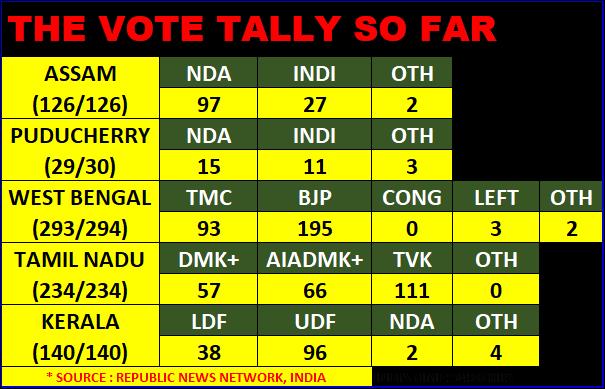
VOTE TALLY RECORDED AT INDIA TIME : 14:00 HRS
While final results and seat tallies continue to be confirmed, the emerging trends already point to a decisive electoral moment. The BJP’s performance in Assam, West Bengal, and Puducherry not only strengthens its political capital but also reinforces the narrative of a party in expansion mode, with Modi at the helm steering its strategic direction.